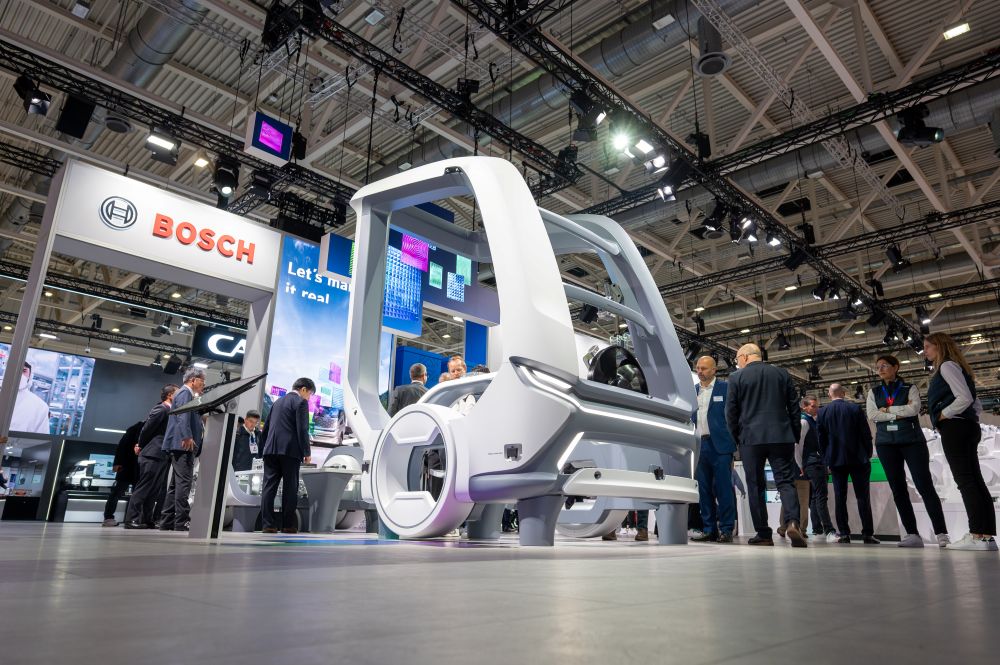
Bosch arrived at IAA Transportation 2026 with a clear message; the truck of the future will run on software. Its central vehicle computers bring cockpit, motion, energy and body functions together, allowing quick over-the-air updates. For cleaner freight, the company offers every route, from a rigid e-axle for 18 to 49-tonne trucks to fuel cell systems of up to 300 kW and hydrogen engines. Safety gets smarter too, with drowsiness detection built into digital side mirrors, an AI-powered camera and a new radar from 2027.
At the show, the company laid out its plan to bring the software-defined vehicle from passenger cars to trucks, with powerful central computers running steering, braking, powertrain and safety systems as one connected team.
According to a couple of company officials, the reason is that engineers are still making parts lighter, stronger and more efficient, but every component eventually reaches its physical limits. Steering and powertrain systems are already very advanced, so the future gains, from hardware alone will be small steps. Software, on the other hand, can coordinate many technologies inside a vehicle “with one intelligence.”
Today, almost every system in a truck has its own electronic control unit (ECU), and their number has grown rapidly. To manage this, the industry is shifting towards fewer but more powerful computers. The first step is domain and zonal architectures, in which high-performance computers (HPCs) take charge of entire areas of the vehicle, such as the body, infotainment, powertrain, braking, steering, chassis and trailer.
A single central computer may follow one day, though that is still far off.
Source link