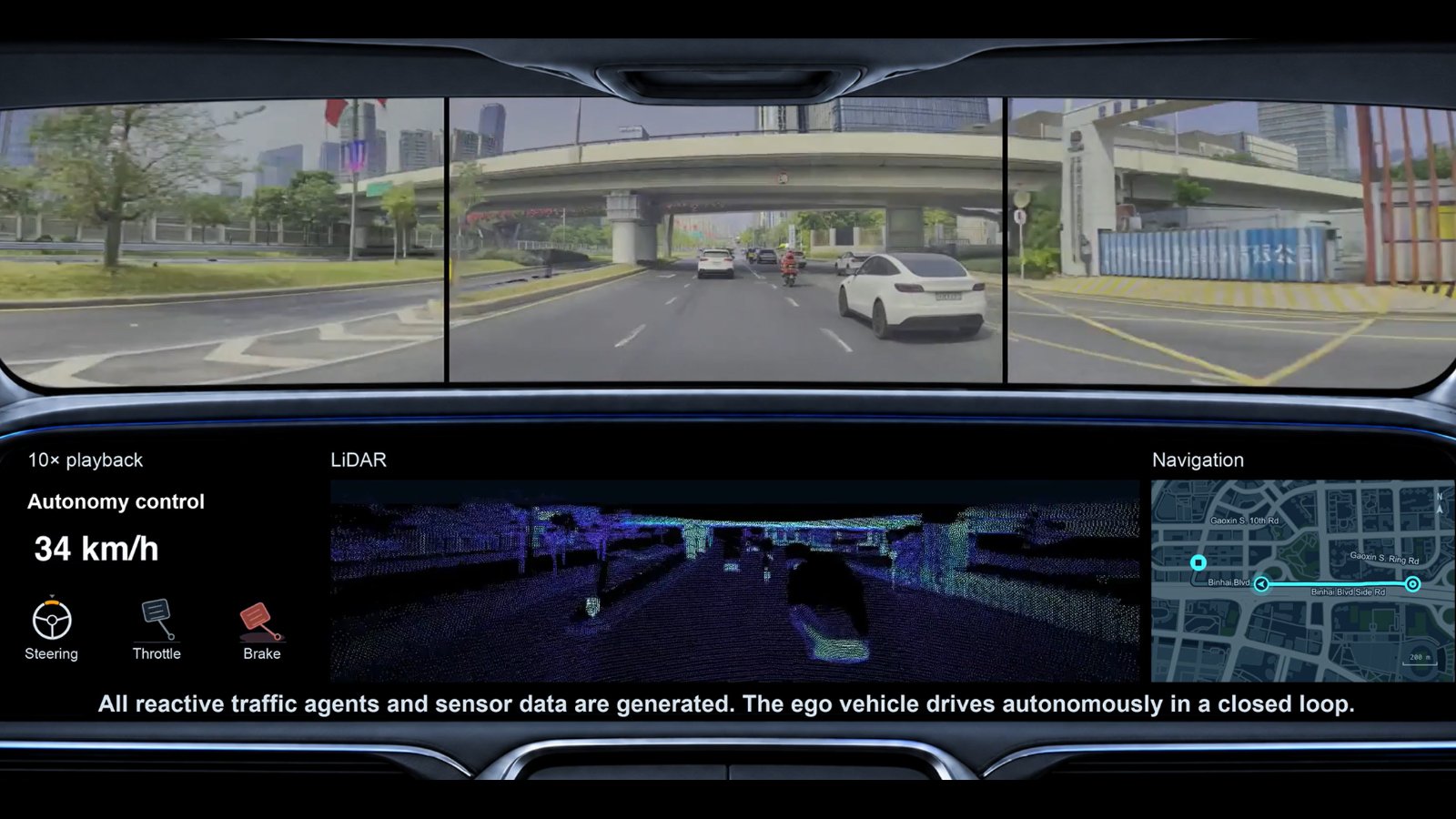
Baidu (NASDAQ: BIDU) has unveiled Apollo World, a world model that uses AI to create interactive virtual traffic environments where autonomous driving systems can train and validate driving strategies.
The Chinese technology giant said in a November 4 statement that the model is already being used for global testing and validation of its Apollo Go robotaxi service.
According to the company, the virtual road test mileage completed by Apollo World in a single day is equivalent to about three years of continuous driving by a real test vehicle equipped with a safety driver.
Baidu aims to let driverless vehicles complete entire trips in virtual cities, from accepting bookings and picking up passengers to dropping them off, before entering new markets. The goal is to reduce real-world testing costs and deployment risks.
Vehicles, pedestrians and other road users in Apollo World are AI agents capable of making decisions and interacting, rather than following fixed scripts, according to Baidu.
When a driverless vehicle slows down, changes lanes or yields, other agents adjust their behavior accordingly. The model also generates multimodal observation data in real time, including camera images and LiDAR point clouds.
The driving system makes decisions based on those inputs, after which the model updates the traffic environment and generates new observations. This creates a continuous closed loop of perception, decision-making, action and feedback.
Wang Liang, chief architect of Baidu's Intelligent Driving Group (IDG), said at the Baidu AI Day Apollo session in Shenzhen on Tuesday that world models should focus on reproducing physical laws and behavioral causality, rather than simply generating realistic images.
Source link