Cars could help clean the air along the roads they travel, with researchers in South Korea developing a vehicle system that captures airborne particles and collects brake dust before it escapes into the surroundings.
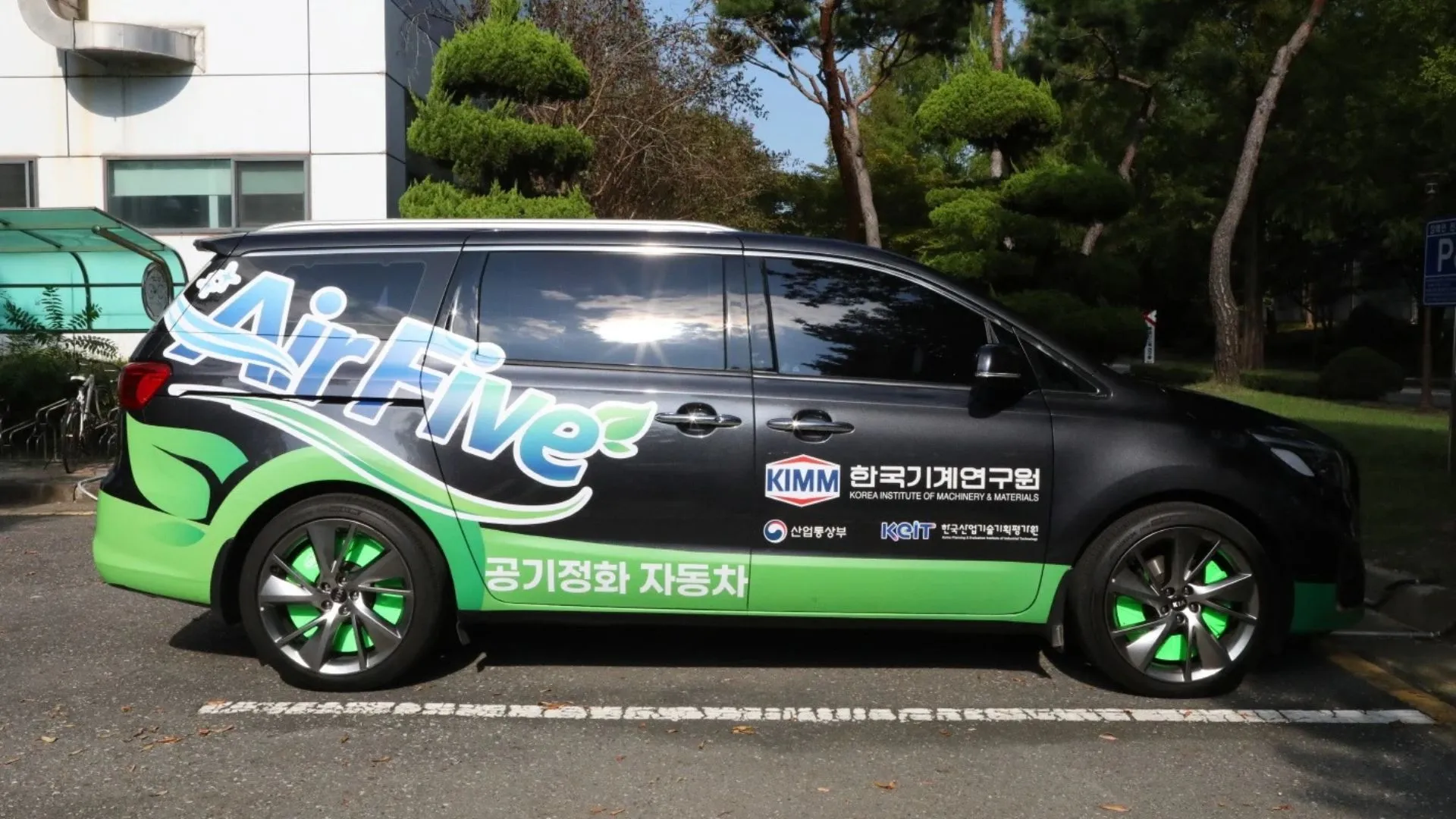
A team led by Dr. Bangwoo Han at the Korea Institute of Machinery and Materials (KIMM) tested the technology on vehicles including a Kia Carnival and Hyundai Sonata.
The approach integrates pollution control into existing vehicle components, addressing both roadside particulate matter and particles generated during braking.
The grille-mounted system uses electrostatic precipitation to collect particles from incoming air. It electrically charges the particles, then attracts them to collection plates.
Carbon fibers much thinner than a human hair enable collection using low electrical current while minimizing ozone generation. During driving, airflow from the vehicle’s movement carries air through the system, eliminating the need for a separate high-power blower.
Tests showed that the grille system removed at least 95 percent of PM2.5 and at least 99 percent of particles in the PM2.5–10 range at 18.64 miles per hour (mph). It maintained those removal levels at 31 mph and purified about 1,000 cubic feet of air per vehicle per minute.
Fuel efficiency changes after installation and remained within 1 percent for both vehicle models.
A second collection device sits behind the brake caliper, capturing particles produced by friction between the brake pads and discs.
These particles naturally acquire an electric charge during braking. The system uses that charge to collect them without a separate particle charger or suction fan.
Source link