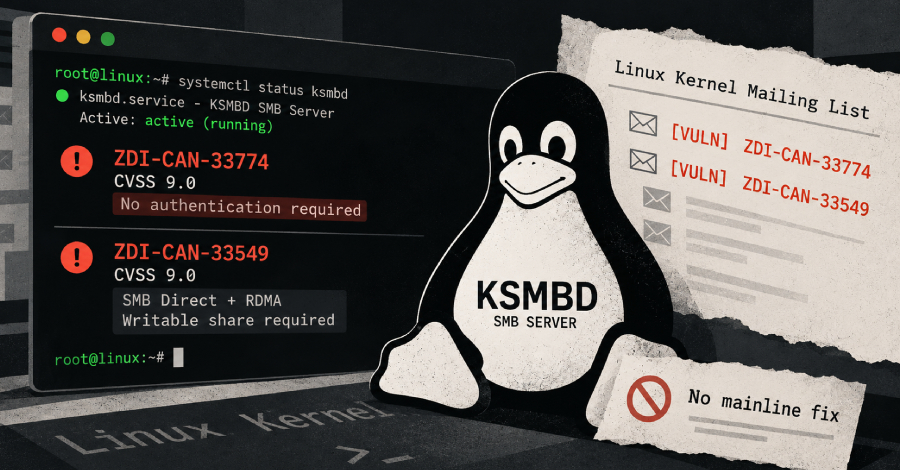
Linux servers running KSMBD, the kernel's built-in SMB server, are exposed to two publicly reported remote code execution flaws rated 9.0 by Trend Micro's Zero Day Initiative, with no fix yet in the mainline kernel.
One of them, ZDI-CAN-33774, can be triggered before any network authentication. The other, ZDI-CAN-33549, requires the SMB Direct transport and an RDMA-capable network interface.
ZDI-CAN-33549 is an integer underflow in KSMBD's SMB Direct path. A client can supply RDMA buffer descriptors in which the first is longer than the declared payload, causing the server's size counter to wrap and allowing a subsequent memory copy to overrun the end of an allocated buffer.
It requires three things: an RDMA-capable interface (hardware or the rxe software driver), a writable KSMBD share, and a client negotiating SMB Direct.
ZDI-CAN-33774 requires no authentication, exposing any server running KSMBD on port 445. The flaw is a race in how KSMBD assigns its handler table: a burst of short SMB1 packets followed by an SMB2 packet in the same TCP write causes workers to handle SMB1 data with an SMB2 handler, reading past the end of the shorter buffer. A path to writing past the buffer also exists once an attacker has access to a share.
As of Thursday, neither flaw has a named fix in the mainline kernel or in linux-next , the integration tree that feeds it. Linux news site Phoronix said SMB Direct maintainer Stefan Metzmacher submitted a fix for ZDI-CAN-33549 targeting the next kernel development cycle, but this has not been confirmed elsewhere.
Source link