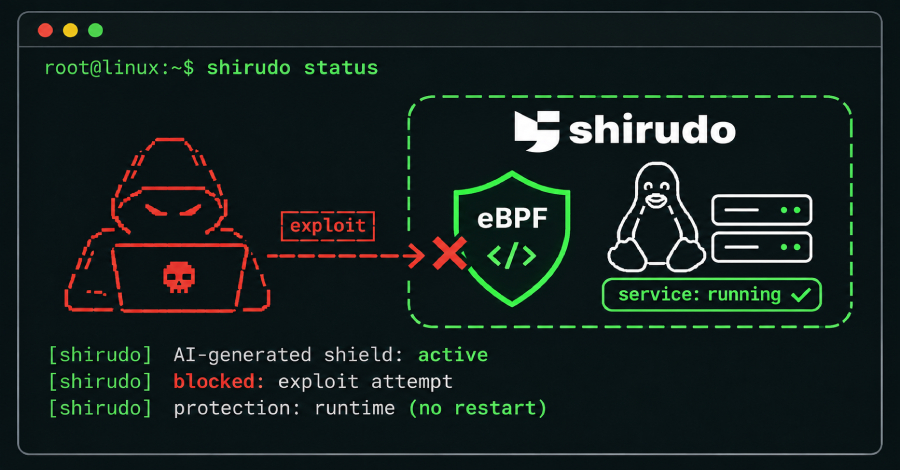
OpenAI and Cisco have teamed up to launch Shirudo (meaning "shield" in Japanese), an open-source Linux runtime that allows artificial intelligence (AI) agents to defend systems without downtime.
"It lets agents write dynamic eBPF controls to shield systems from exploits, giving defenders more time to test and roll out patches," OpenAI said in a post on X.
The AI upstart called the initiative a "first step" toward "self-defending infrastructure" that can adapt itself to new threats while the services continue to run and enable defenders to test and deploy fixes without any disruption.
The development comes as AI is accelerating vulnerability discovery, finding critical bugs in foundational software used to power internet-connected software.
Shirudo is being pitched as a way for defenders to test temporary safeguards (aka shields) and check if they block behavior that exposes a vulnerability, while letting legitimate requests pass through. Once a shield is approved by an operator, it can be deployed without having to stop the service.
The idea is to avoid a complete service disruption to block a line of attack simply because both an exploit and a legitimate request may rely on the same underlying Linux operation.
To achieve this, Shirudo makes use of eBPF (short for extended Berkeley Packet Filter), a technology that makes it possible to run lightweight, sandboxed programs inside the kernel without the need for modifying the system code or restarting it.
"eBPF is a highly efficient, sandboxed virtual machine in the Linux Kernel," Cisco's Isovalent said . "These eBPF programs allow you to interact with the Linux kernel to observe and take action on any events happening on a machine.
Source link