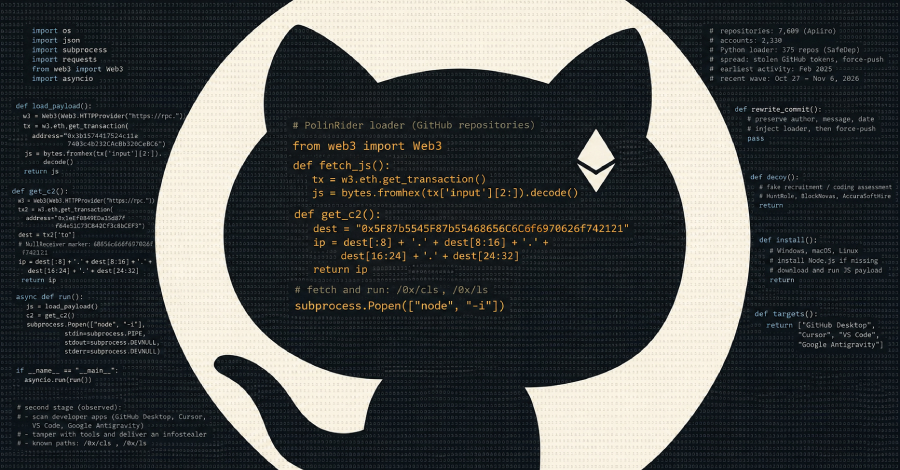
The threat actors behind the PolinRider campaign have been observed planting a Python loader in GitHub repositories, as evidence emerges that the activity may have started as far back as February 2025.
"The loader hides in a small utils package or in conftest.py," SafeDep said in a report published this week. "When Python imports the file, the loader reads the newest transaction that an Ethereum wallet sent to itself. It decodes the input data of that transaction as JavaScript and runs it with Node.js."
The JavaScript code, for its part, reads a second wallet to locate the command-and-control (C2) server and then passes the next stage to a detached interactive Node.js environment by means of a node -i process.
The software supply chain security company said it identified the loader in 375 public repositories that belong to 260 accounts. There is no evidence that the loader has been distributed via PyPI or npm.
PolinRider is the name assigned to a malicious campaign linked to North Korean threat actors. Recent reports indicate that the activity employs various channels to distribute malware, including -
At a high level, the PolinRider loader retrieves an encrypted second-stage Node.js payload that scans the infected host for installed developer applications, such as GitHub Desktop, Cursor, VS Code, and Google Antigravity, and tampers with the most frequently used tools to execute attacker-controlled code and deliver infostealer malware.
It's worth noting here that PolinRider is assessed to be a sub-cluster operating in parallel with a long-running campaign codenamed Contagious Interview .
Source link