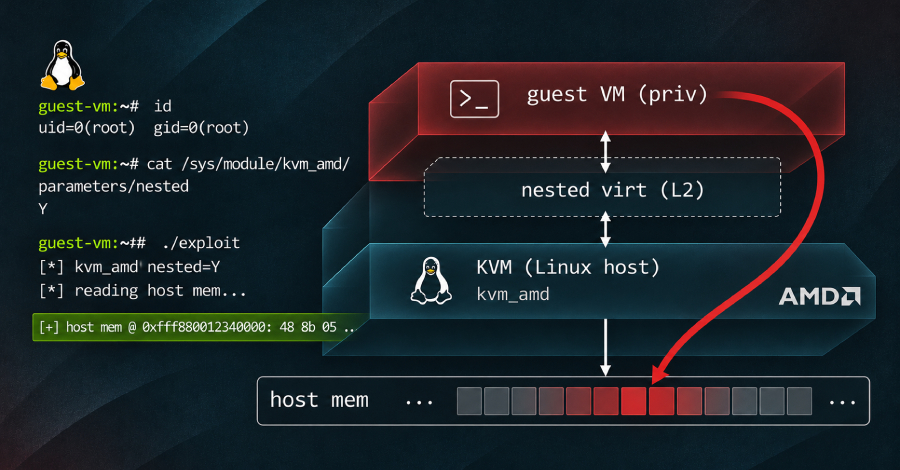
A flaw in KVM, the hypervisor built into the Linux kernel, let researchers read about 127 GB of a cloud server's memory from inside a virtual machine of their own on DigitalOcean.
On a shared server, that memory can include other customers' virtual machines. The flaw, tracked as CVE-2026-99312, affects only hosts with AMD processors and nested virtualization enabled.
Fixed kernels shipped upstream on Tuesday, the day before the research went public. The provider patched its own fleet with a live patch, telling Droplet customers: "No action needed on your part." Operators who run their own KVM hosts on AMD hardware need to update the host kernel or turn nested virtualization off.
Oren Yomtov, a researcher at the security firm Terra Security, found the flaw and reported it through the provider's bug bounty program. The provider confirmed the exploit worked on its own hosts and treated it as critical, and the Linux KVM maintainers, told on October 21, merged a fix on November 2.
In the test on one of its Droplets, the first thing to come back was the host's kernel version banner, followed by about 127 GB of the host's RAM, mapped read-only, the provider said in a disclosure post yesterday.
The write test ran on the researchers' own bare-metal AMD server, with no other customers attached. There, the guest wrote 32 chosen bytes into a live page of the host kernel's memory, and a witness module loaded into that kernel confirmed the change.
Source link