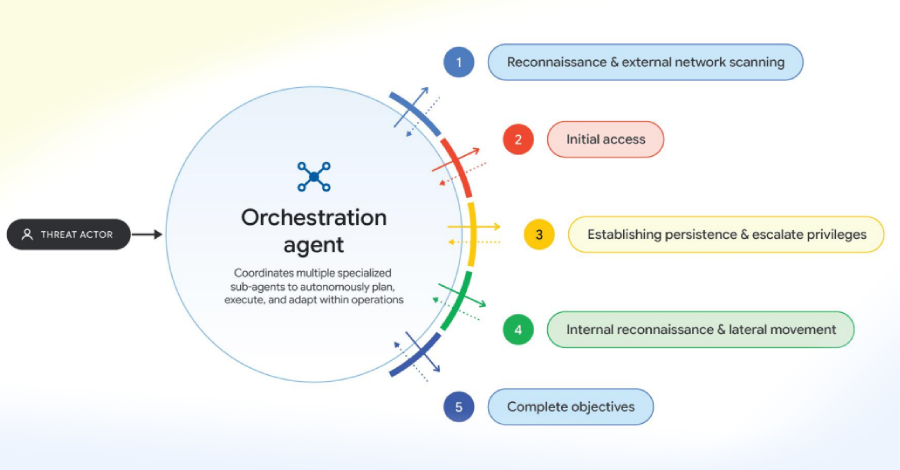
Google on Monday revealed that adversarial use of artificial intelligence (AI) by threat actors has gone beyond manual prompting to deploying autonomous multi-agent offensive frameworks like ARTEX, CAIRN, CyberStrikeAI, and PentAGI to execute multi-stage intrusions at greater operational velocity.
In tandem, threat actors are leveraging the power and capabilities of large language models (LLMs) and agentic frameworks to automate the reverse engineering of patches via differential analysis, allowing them to rapidly weaponize newly disclosed vulnerabilities, as observed in the case of PaperCut NG/MF flaws earlier this September.
The abuse of open source, agentic penetration-testing (pentesting) frameworks is seen as a way to "automate discrete phases and specific operational tasks during live intrusions," Google Threat Intelligence Group (GTIG) said in a report shared with The Hacker News.
The tech giant said the adoption represents a paradigm shift in which cyber attacks take place at machine speed, allowing the operations to be scaled significantly by chaining together varied attack paths even if the underlying mechanics remain the same.
A number of threat actors have been observed experimenting with these frameworks and harnesses, including financially motivated and suspected espionage actors aligned with China.
"These observations additionally extend to the use of other tools and services, such as ZeroHollow, an inference service used for exploit development and LLM routing, and Agent Zero, an open source agent framework which features autonomous code execution and dynamic tool generation," Google said.
Another key area of misuse revolves around automating labor-intensive tasks like vulnerability analysis and proof-of-concept (POC) weaponization using LLM-driven pipelines, allowing threat actors to collapse the window between patch disclosure and active exploitation.
Source link