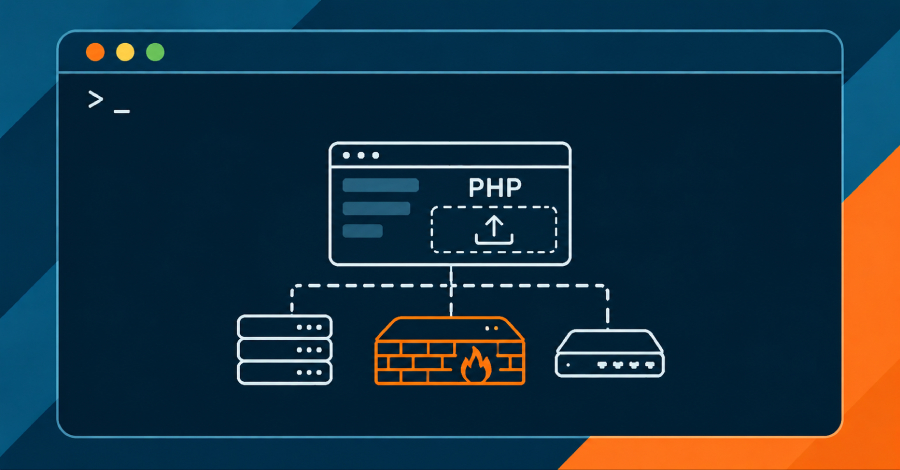
One of the early targets of PHP2Shell exploitation was the firewall. On October 28, Palo Alto Networks confirmed that attackers were exploiting the two PHP vulnerabilities, CVE-2026-109618 and CVE-2026-109619, against PAN-OS management interfaces exposed to the internet. Both flaws let anyone execute code on the web server without authentication. The disclosure itself went a little wrong. Details leaked on October 20, ahead of the coordinated release, and the PHP project shipped an emergency patch the next day.
The vulnerabilities require no authentication, but they are not easy to exploit reliably. It takes skill and additional knowledge about the target system. Where it matters a lot is appliances, which run identical, often outdated software that an attacker can study in advance. That is the bigger picture. An awful lot of web applications control critical devices in your network. Almost anything is a web application to some extent. That often goes unrecognized, and as a result those applications aren't adequately protected.
Everything is a web application. That is the motto of the SANS course I teach, SEC522: Application Security: Securing Web Applications, APIs, and Microservices. Web application security has traditionally been treated as a developer issue, yet anyone protecting a network must understand how web applications work to properly defend them.
On ordinary web servers, address space layout randomization (ASLR) is one of the features that makes exploitation harder. It shuffles where code and data sit in memory, so an exploit can't rely on fixed addresses. VulnCheck's early analysis found the bugs exploitable on ARM64 systems and on x86 systems without ASLR.
Source link