The in-house Python script behind eMudhra's October key compromise has now cost the company 8 more of its intermediate certificate authorities (CAs), even though it did not weaken their keys.
Each intermediate CA has its own private key, which the company uses to sign the certificates it issues. The 8 intermediate CAs compromised in October had a different problem: a single line in the script cut each of their keys to one byte, the company said this week.
The script also retrieved the RSA keys of the 8 newly revoked CAs from the company's hardware security modules (HSMs). The company says it cannot show that the keys were handled as required by its own rules. It revoked the CAs late last week.
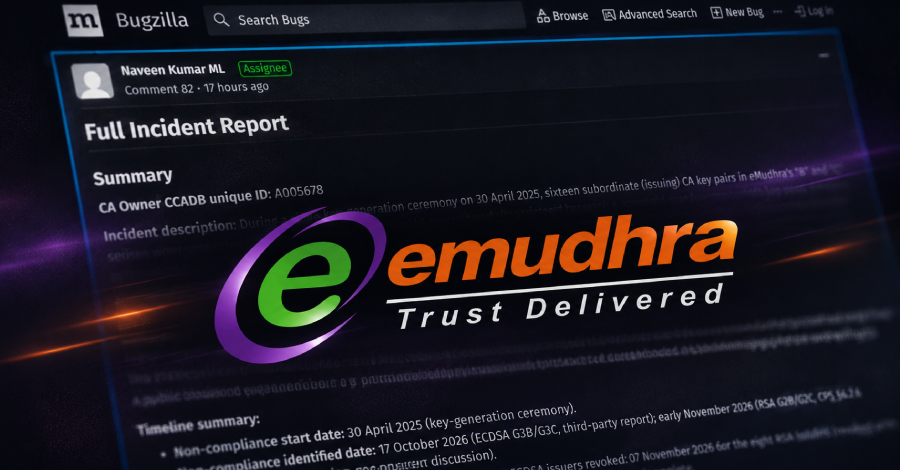
The company had called those CAs unaffected. "The RSA issuers went through a different path as per our assessment of the code and are therefore not impacted," it wrote on Mozilla's bug tracker on October 19.
Of the 8, 6 were for website (TLS) certificates and 2 for code signing. The company had put 4 of them into production in May. Its list names 195 certificates from them, 29 for its own domains.
Both problems began at a key ceremony on April 30, 2025, according to the full incident report the company posted to the same bug tracker this week. That day it generated 16 CA keys on Utimaco HSMs, including the 8 behind the October key compromise.
The keys were meant for Crypto4A HSMs at the company's US and EU sites.
Source link