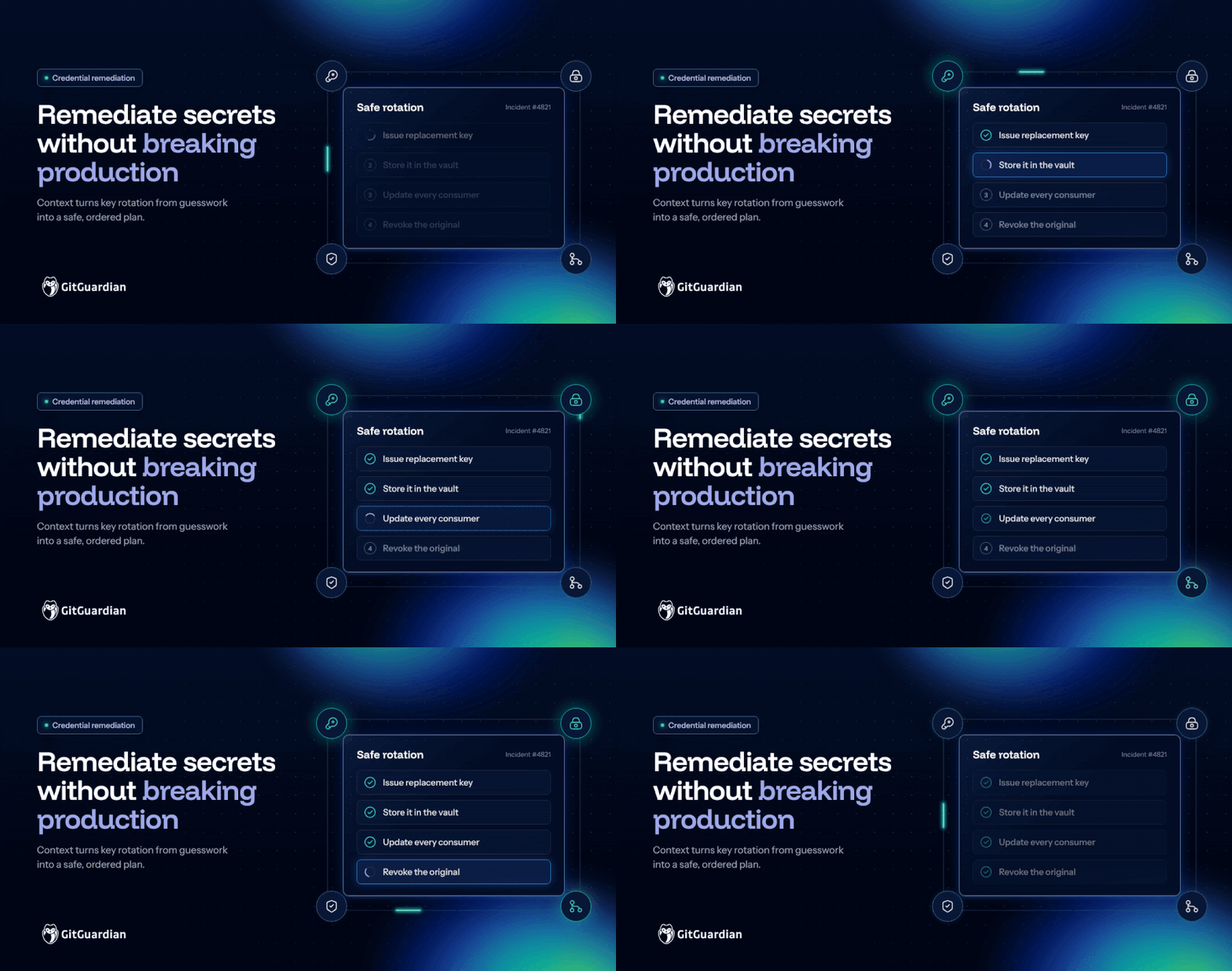
Every modern enterprise depends on credentials. This is how humans, systems, and now AI connect securely to data, services, and each other. GitGuardian helps secure that credential layer through three connected capabilities: Detect, Remediate, and Prevent. The journey starts with detection, but credential remediation is where many secret security programs bog down. This is the second of three articles we are releasing to explain how we help address detection, remediation, and prevention.
The first article in this series, “The Credential Layer Is Expanding Faster Than Security Teams Can See It,” covered detection across every surface where credentials live. Just knowing they exist is not enough. Teams need to take action to remediate those findings. To do that, they need context around every credential they find.
Without the right context, it is impossible to know what risks the secret carries. It is also difficult to understand which systems rely on those secrets and the risk levels that revoking the secret brings. Nobody wants to break production, but we also cannot allow attackers to leverage those secrets.
The resulting decision paralysis leaves many teams struggling to rotate immediately. Sometimes it can take years for the secret to be revoked finally. That is actually all too common, as shown by GitGuardian’s State of Secrets Sprawl 2026 research that found that 64% of valid secrets discovered in 2022 still worked in January 2026, a full 4 years later.
It would be great if there were a one-size-fits-all solution for remediating every leak; in reality, each one is tied to a specific integration.
Source link