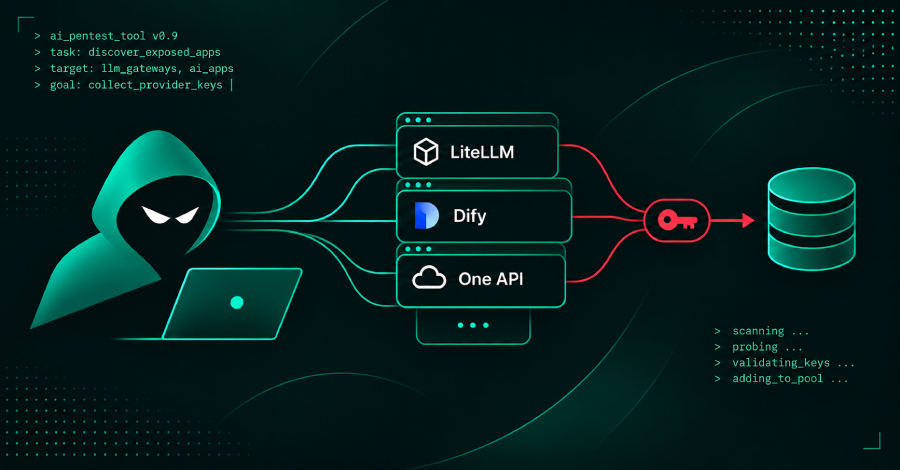
Attackers' AI agents have been hunting for weak spots in internet-exposed AI apps such as LiteLLM, One API, and Dify to steal the AI provider keys stored inside, according to the agents' own records.
The records, which Amazon's threat intelligence team captured with decoy servers, describe stolen keys being used to run the AI models that powered the search for more keys.
The team said this week that it cannot verify the outcomes reported by the agents. It has moderate confidence that the agents ran on ARTEX, an open-source AI tool for penetration testing.
The records include a playbook of known entry points for each targeted product. It lists default administrator credentials such as LiteLLM's default master key, unfinished installs that an outsider could take over, and known flaws in Langflow and RAGFlow.
In a separate case reported this week, Cloudflare's incident responders saw ARTEX gain access to a compromised API token that had been used for CI/CD. The token had no IP restrictions or rate limiting, and the activity that followed included 400 database dump requests in an hour. The company has not said whether those requests returned any data.
An operator gives ARTEX a target and a goal, and a planner agent splits the goal into tasks for worker agents that run security tools. To decide each next step, the agents send their work to a large language model (LLM).
The decoy servers, part of a network called MadPot , posed as popular LLM services.
Source link