In the space of a month, a new category of AI model went from nonexistent to everywhere. TypeSafe AI released Jev on September 15 and called it a System One model, a nod to Kahneman's fast, intuitive thinking. OpenAI announced its own Decisions API at DevDay and opened a public beta on October 6. Cribl published cribl-decision, an open LoRA adapter you can run locally. Others, like Laya, are already showing up in open source tooling.
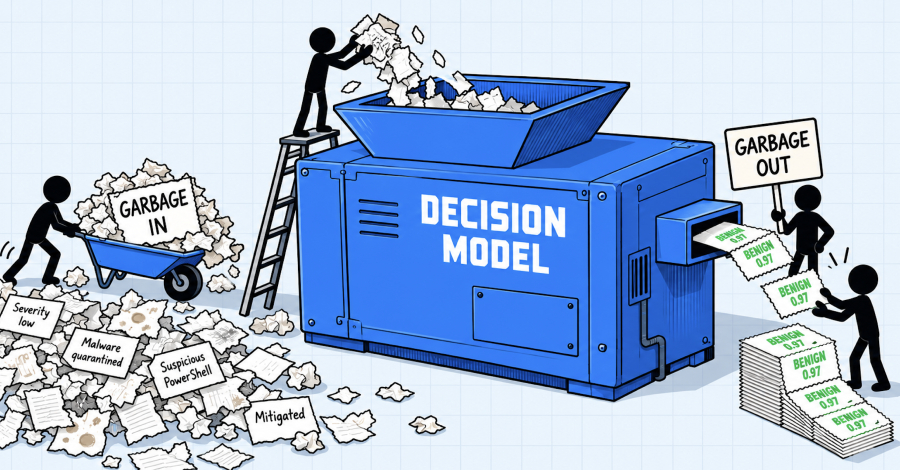
These models skip text generation entirely. You hand them some state and a set of typed questions. They hand back a choice, a score, or a yes/no with a probability attached.
For security operations, I think this is some of the best news of the year. I also think most of the conversation is pointed at the wrong layer.
You get a number you can automate against. A typed answer with a calibrated probability is something you can put a threshold on. Ask the model whether an alert is benign and you get back a probability. Close it automatically above 0.97. Below 0.6, treat it as a likely incident and escalate it. Anything in between goes to an analyst for a closer look. TypeSafe even suggests stricter thresholds for irreversible actions, which maps neatly onto “disable an account” versus “add a comment to the ticket.”
They're cheap enough for every alert. Jev is priced at $42 per billion input tokens, with responses in 70 to 500 milliseconds. Say an enterprise sees 450,000 alerts a year and you feed a few thousand tokens per alert.
Source link