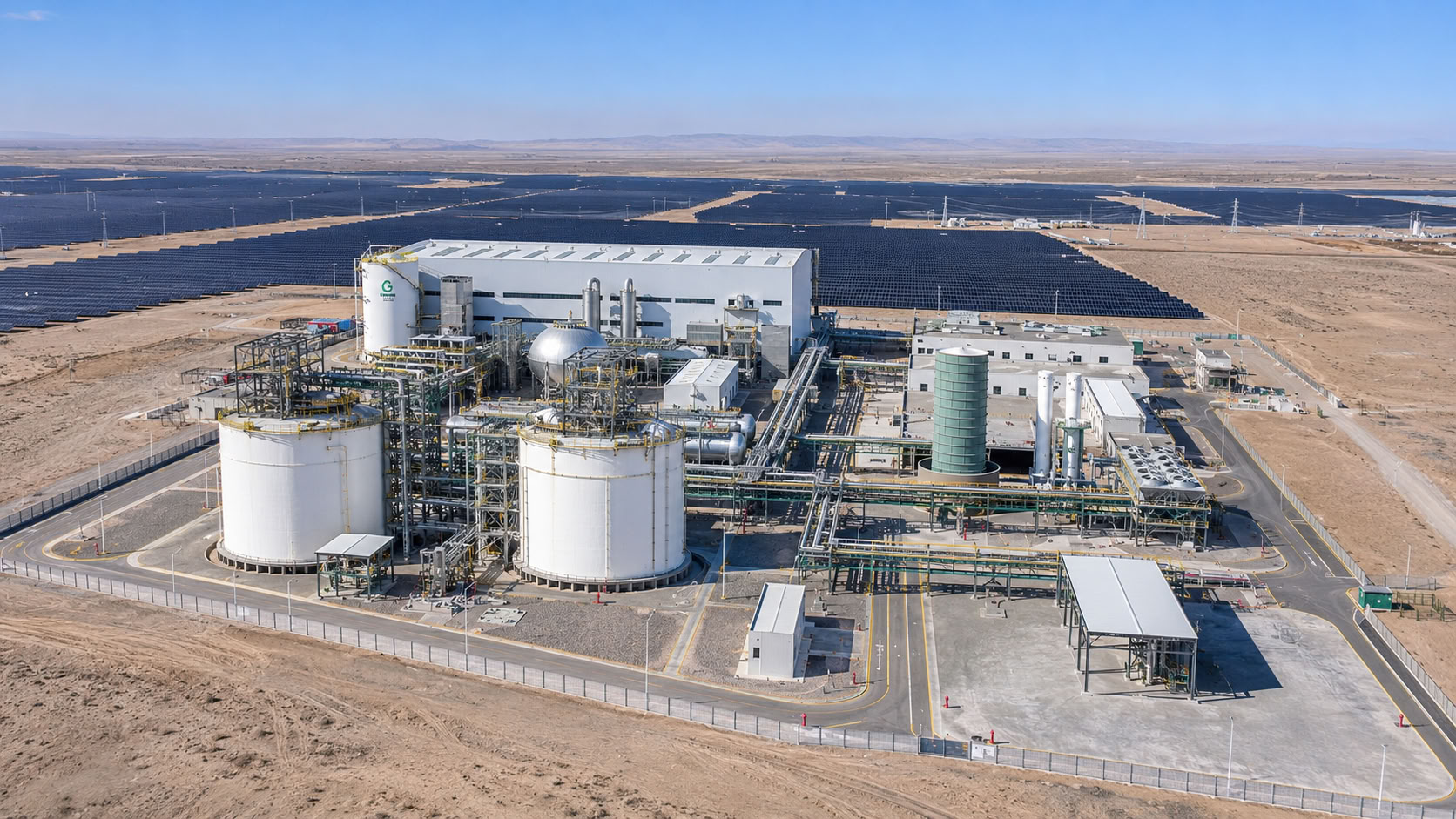
A 60 MW/600 MWh liquid air energy storage (LAES) demonstration project in Qinghai province, northwest China, was connected to the grid and began generating electricity on October 30, marking a significant step toward the commercial deployment of large-scale cryogenic energy storage.
Located in Golmud, Haixi Mongolian and Tibetan Autonomous Prefecture, the facility was developed by state-owned China Green Development Investment Group (CGDG) in cooperation with the Technical Institute of Physics and Chemistry of the Chinese Academy of Sciences (CAS).
The developer describes the project as the world’s largest grid-connected liquid-air energy storage facility by both rated power and energy capacity.
Construction began in July 2023. The project was selected for China’s national new-type energy storage demonstration program and included in the National Energy Administration’s list of major first-of-a-kind energy technologies and equipment.
With a rated output of 60 MW and a storage capacity of 600 MWh, the facility is designed to deliver electricity continuously for 10 hours. According to CGDG, it could accommodate approximately 600 MWh of surplus renewable electricity daily and supply an estimated 180 GWh to the grid annually, equivalent to the electricity consumption of around 30,000 households.
The system uses ambient air as its working fluid, avoiding the need for electrochemical batteries or underground storage caverns.
When charging, surplus electricity drives a three-stage centrifugal compressor, pressurizing purified air to approximately 7 MPa. Heat generated during compression is recovered and stored as hot water at temperatures reaching 195 C.
The compressed air then passes through a multistage cooling process before being liquefied at approximately -194 C and stored in insulated cryogenic tanks at near-atmospheric pressure.
Source link