
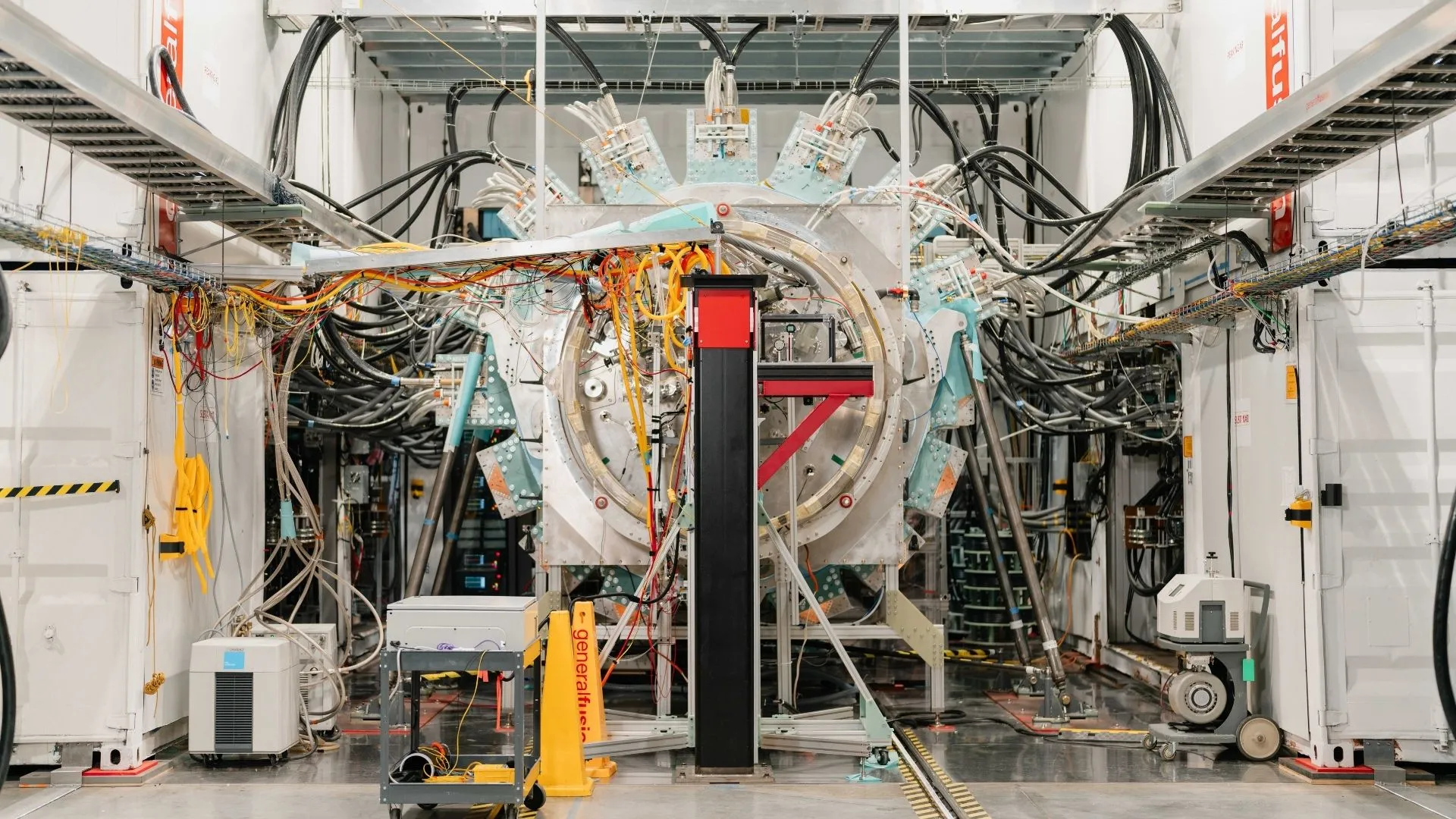
Scientists have superheated a trapped plasma to more than 12 million degrees Celsius (21.6 million degrees Fahrenheit). This milestone crosses a crucial threshold for commercial fusion energy.
The benchmark was achieved by Canadian technology firm General Fusion inside its experimental prototype, the Lawson Machine 26 (LM26). The device reached electron temperatures of 1.1 kiloelectronvolts (keV) just before peak compression.
In fusion physics, surpassing 1 keV is an internationally recognized milestone. Only a handful of experimental reactors worldwide have ever reached it.
“General Fusion has a two-decade track record of achieving industry-first milestones in Magnetized Target Fusion supported by a substantial body of peer-reviewed scientific literature,” said Greg Twinney, Chief Executive Officer at General Fusion.
“We built LM26 to achieve important technical milestones that will help get us to a first-of-a-kind plant in the next decade, and step-by-step we are advancing on this path.”
Until now, every laboratory that passed this mark used massive superconducting magnets or high-powered lasers. General Fusion chose a different path. It uses a mechanical method called Magnetized Target Fusion (MTF). It is the first machine in history to hit this temperature using low-speed, physical compression.
Most modern fusion ventures rely on extremes. Some fire enormous lasers at fuel pellets for mere nanoseconds. Others trap plasma inside intricate magnetic cages. General Fusion instead injects magnetically confined plasma into a chamber and crushes it over several milliseconds using a contracting solid metal wall.
Mechanical compression of the fuel avoids the need for rare, delicate materials. Commercial plants will use a circulating liquid-metal barrier.
Source link





