
This article has been reviewed according to Science X's editorial process and policies. Editors have highlighted the following attributes while ensuring the content's credibility:
Where a freshwater river meets the salty sea, the natural difference in salinity creates an enormous theoretical source of clean, renewable energy known as "blue energy" or osmotic power. Yet for decades, physical devices built to harvest this 24/7, carbon-free electricity have underperformed laboratory predictions by factors of thousands, leaving developers reliant on slow and costly trial and error.
Now, mechanical engineers from Ben-Gurion University of the Negev (BGU) have formulated the first self-consistent theoretical framework that accurately accounts for realistic system physics, identifying why real-world power yields consistently fall short. The study, led by professor Yoav Green alongside co-lead authors Oren Lavi and Dr. Ramadan Abu-Rjal from BGU's Department of Mechanical Engineering, is published in PRX Energy.
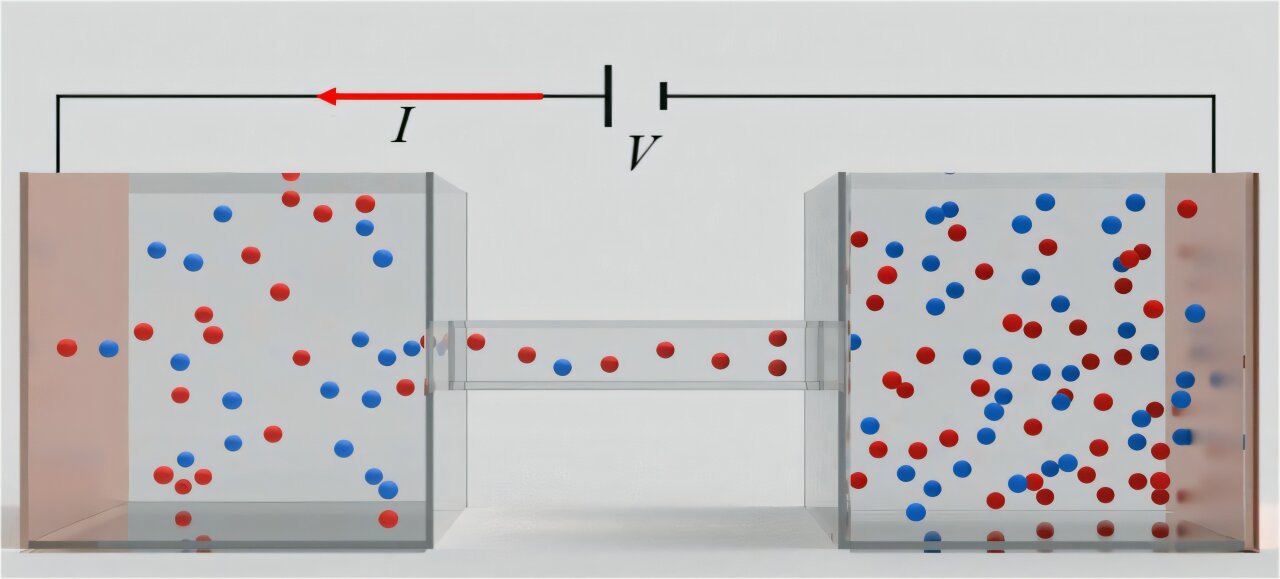
Osmotic power devices typically rely on reverse electrodialysis (RED), using charged membranes pierced with nanoscale channels. As salt ions move across the charged channels to equalize the concentration differences, their motion creates an electric current that can be harvested as usable power.
However, traditional mathematical models oversimplified these systems. They evaluated only the microscopic membrane itself under idealized conditions, predicting performance that experiments were unable to achieve. They ignored the effects of the larger fluid reservoirs on either side.
To overcome this, BGU researchers developed a more realistic model coupling the nanoscale membrane with the flanking fluid chambers. This model rationalizes the long-standing performance gap. They show that the fluid reservoirs create additional non-negligible resistances that reduce the harvestable power estimates by an order of magnitude.
Source link





