
Electricity-system flexibility has become an increasingly large bucket. Batteries go into it. Demand response goes into it. Virtual power plants, EV charging, interconnectors, hydro, thermal storage and grid-enhancing technologies all get described as flexibility too.
Those resources can all be useful, but a national total of “flexible megawatts” does not tell a grid operator very much about whether a congested transformer can take another connection, whether an evening peak can be covered, or whether the system can get through several difficult days.
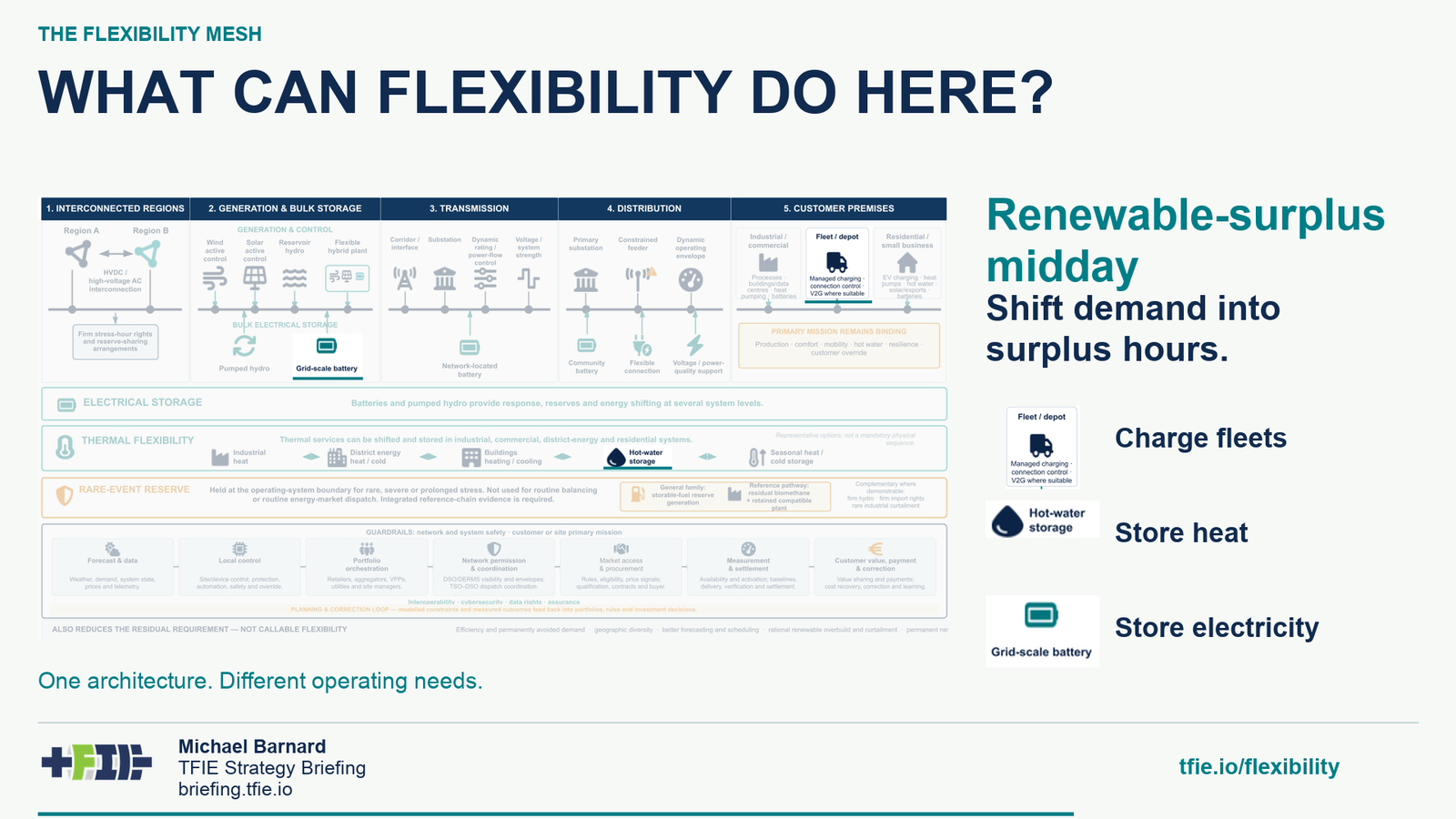
I’ve published a new open 99-page TFIE Strategy report, The Flexibility Mesh: A Whole-System Architecture for Reliable, Affordable Electrification, to put those different jobs into one common architecture.
The animation runs the same underlying electricity system through four operating moments. During renewable-surplus midday, useful actions can include charging batteries and EVs, heating water, increasing some industrial loads and exporting electricity where there is somewhere useful for it to go. Move into an evening or winter peak and batteries discharge, some charging can pause, buildings can use heat stored earlier, hydro can increase output and industrial demand may reduce within its operating constraints.
A local network constraint creates a different problem again. An overloaded transformer does not care that there are thousands of megawatts of flexible capacity somewhere else in the country. The resource has to be electrically relevant to that part of the network. Storage, managed charging, operating measures and eventually reinforcement can all have roles, but they have to be compared against the actual constraint.
Source link