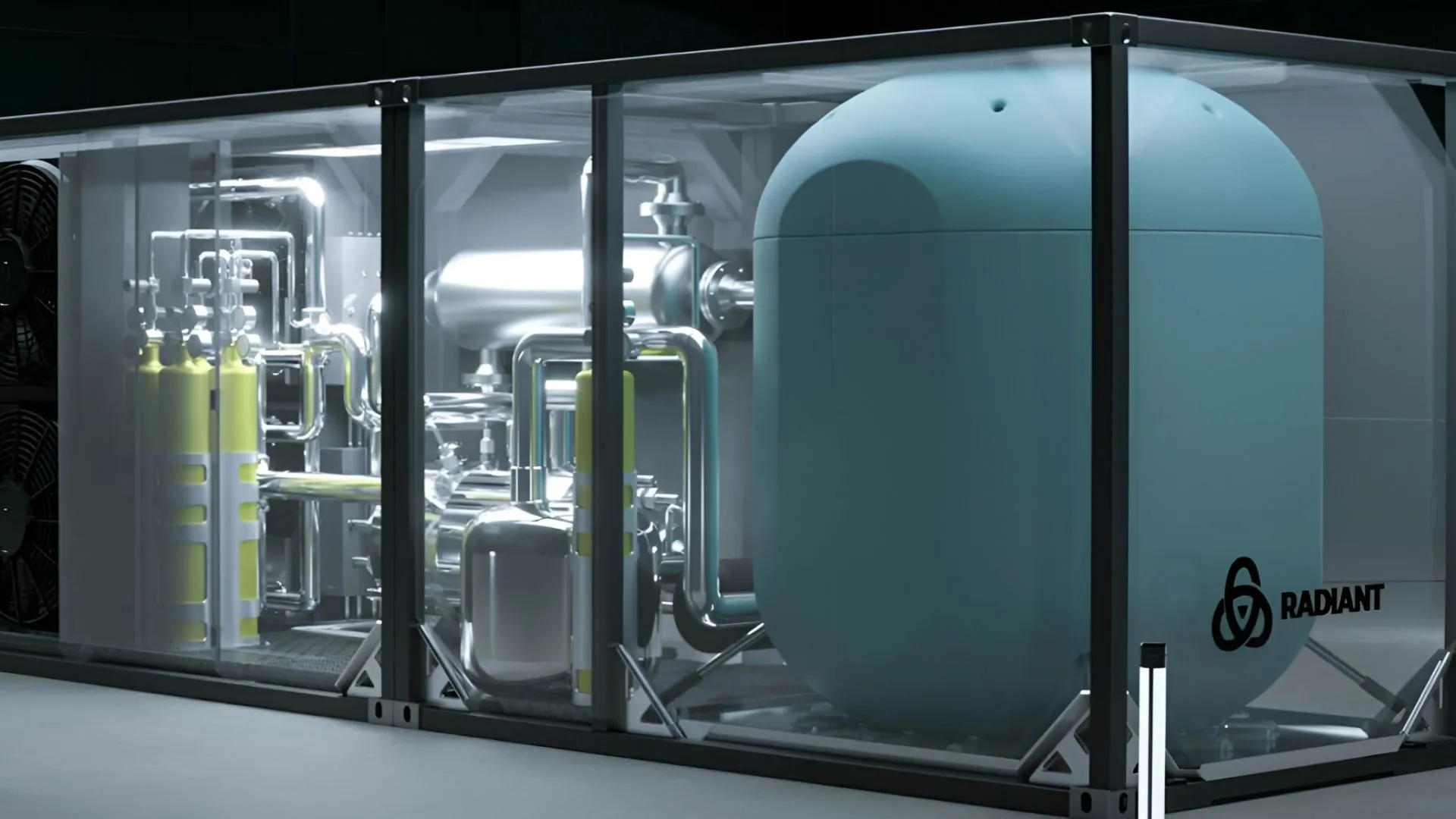
A US nuclear microreactor has cleared a key safety hurdle ahead of a planned test campaign targeting 60 effective full-power days of operation and at least 150 continuous hours without operator intervention.
California-based nuclear technology developer Radiant announced that the US Department of Energy (DOE) has approved the Documented Safety Analysis (DSA) for its Kaleidos microreactor.
The approval brings the reactor closer to full-power testing at Idaho National Laboratory (INL), where Radiant plans to evaluate its performance under operating conditions.
Unlike preliminary tests that establish whether a reactor can sustain a controlled nuclear chain reaction, the upcoming campaign will examine how Kaleidos performs during extended operation.
Radiant says the demonstration will be the industry’s only full-power, extended-duration test of a nuclear microreactor to date.
However, the reactor must first pass DOE’s Readiness Review before nuclear operations can begin.
The planned testing campaign will take place at the National Reactor Innovation Center’s Demonstration of Microreactor Experiments (DOME) facility at INL.
The five-phase program will begin with initial criticality, the point at which a reactor achieves a self-sustaining nuclear chain reaction.
Testing will then progress through increasingly higher power levels, allowing engineers to evaluate the reactor core, instrumentation, and integrated systems under operating conditions.
The campaign targets 60 effective full-power days (EFPD) over several months. This represents the equivalent of 60 days of operation at full power, rather than necessarily 60 consecutive days.
Another major objective is to demonstrate at least 150 hours of uninterrupted operation at full power without operator intervention.
Source link