
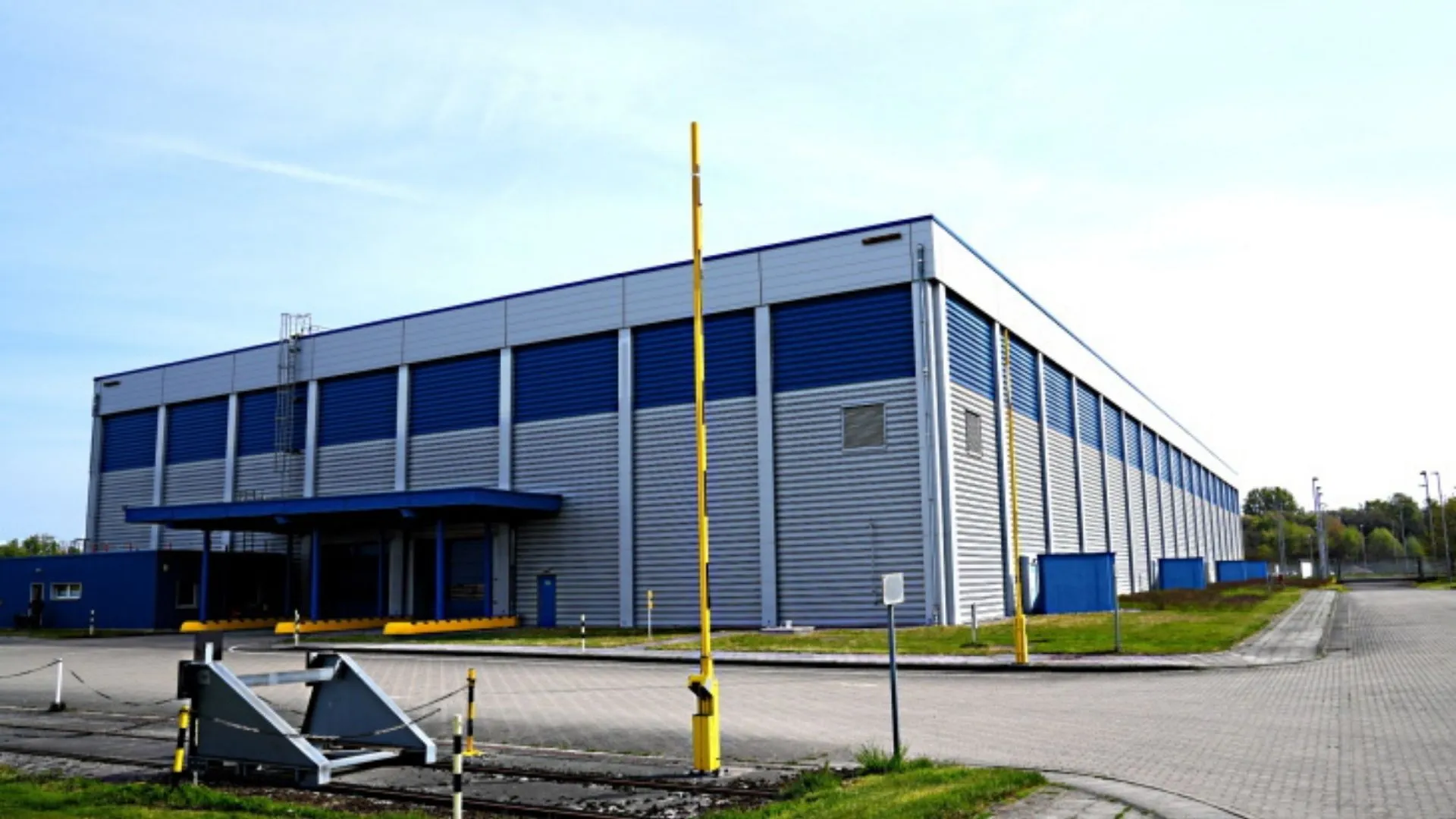
A uranium storage hall completed in 2014 has now officially entered service at Urenco’s enrichment site in Gronau, Germany.
Designed to hold up to 65,000 tons (59,000 metric tons) of uranium oxide, the facility provides long-term storage for depleted uranium produced during enrichment.
Urenco commissioned the building after fulfilling the legal and operational requirements for storing the material on site.
Its operation forms part of a management strategy under which depleted uranium from Gronau undergoes chemical conversion at facilities in France and the UK before returning for storage.
Uranium enrichment increases the concentration of uranium-235, the fissile isotope used to generate energy in nuclear reactors. The process also produces depleted uranium, a by-product commonly called tails, which remains in uranium hexafluoride, or UF6, form.
Urenco’s strategy involves transporting material from Gronau to Orano’s Pierrelatte facility in France and its own Tails Management Facility at Capenhurst in the UK. Both sites chemically convert UF6 into uranium oxide, known as U3O8.
This oxide is well-suited for long-term storage because it does not dissolve in water, is non-combustible, and remains chemically stable. It is also non-volatile even at elevated temperatures.
With the Gronau storage hall formally commissioned, material originating at the site and converted at those facilities can return for long-term storage.
The facility falls under an expansion license granted in 2005 by the nuclear licensing authority of North Rhine-Westphalia. That license permits the Gronau enrichment plant to operate at an annual capacity of up to 4.5 million separative work units.
Separative work units, or SWU, measure the work involved in separating uranium-235 from uranium-238.
Source link





