See more from Canary Media’s “Chart of the Week” column.
Now that solar has become America’s go-to choice for new power plants, the pressure is on to assemble a fully domestic supply chain for the technology. Data from the latest Clean Investment Monitor shows that this onshoring process is well underway.
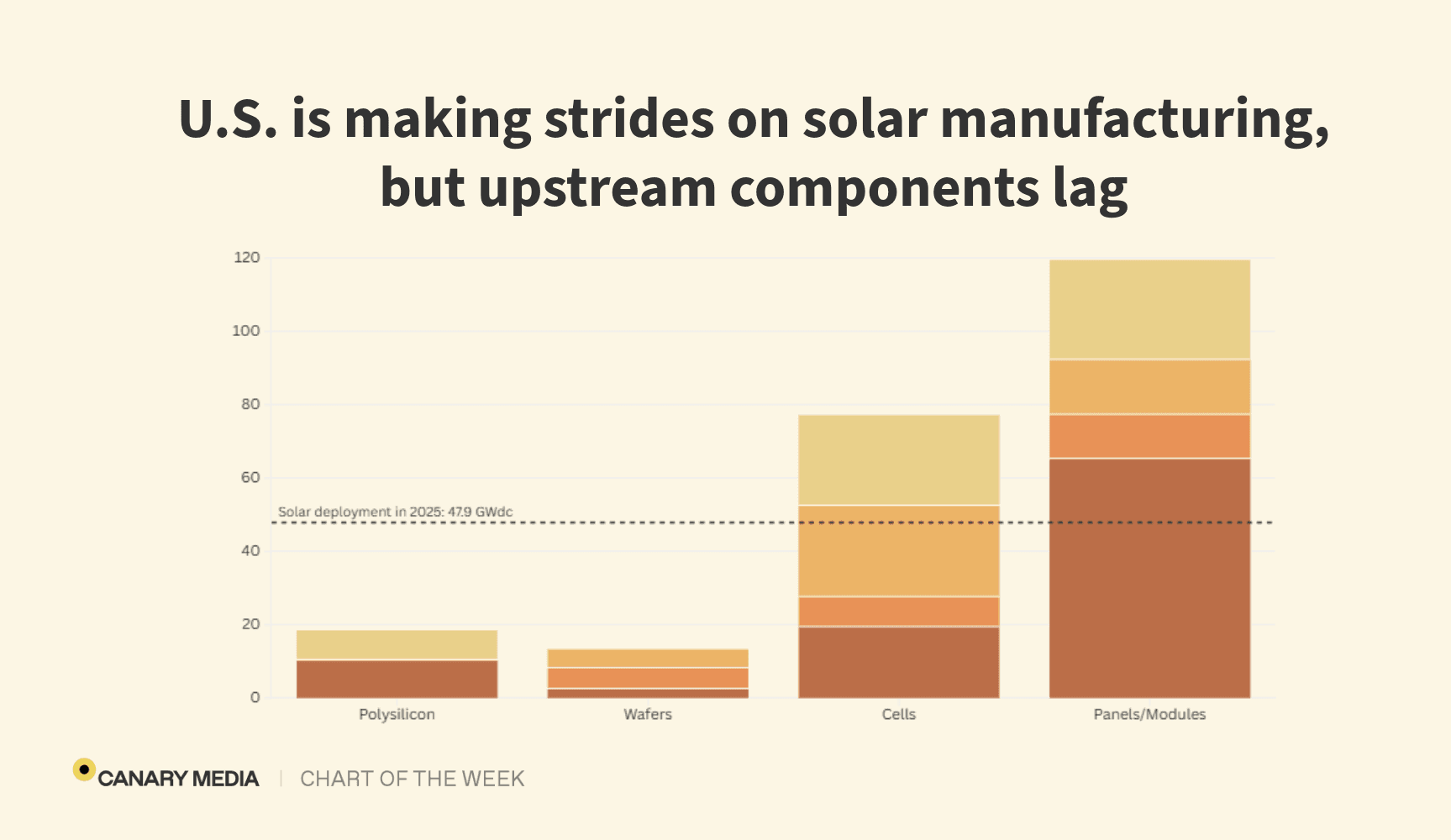
Factories in the U.S. can produce more than enough finished solar panels — also known as modules — to supply the nation’s annual installations, which last year hit 47.9 gigawatts (measured in direct current capacity). Module production could grow by about 83% if all the projects that have been announced or are going through construction and commissioning come to fruition. The expansion represents a major change of fortune for domestic solar manufacturing, which had nearly disappeared, but has blossomed in recent years thanks to federal incentives and stiffer tariffs against foreign products.
Still, the panel is just the final step in the solar supply chain. To truly onshore this critical industry, the U.S. also needs to make the components that go into the module: photovoltaic cells, which are etched onto silicon wafers, which are made from processed polysilicon.
So far, cells have shown the most success among those precursors. Domestic factories can make up to 19.5 GW annually, after several factory openings this year. If projects currently wrapping up construction all come online, the country will be able to make enough solar cells to match 2025 deployments.
The more capital-intensive polysilicon and wafer production, however, is not on track to match the levels for cells or modules.
Source link