This article has been reviewed according to Science X's editorial process and policies. Editors have highlighted the following attributes while ensuring the content's credibility:
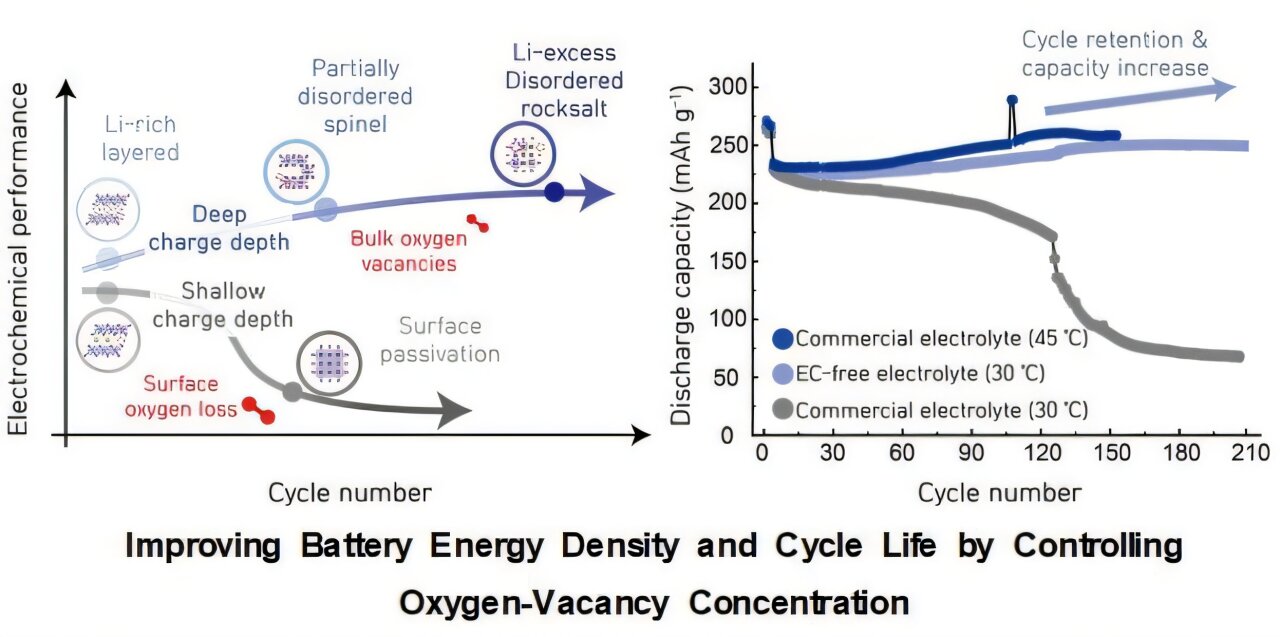
What if a battery could become more powerful as it ages? Much like wine developing a deeper flavor over time, researchers in Korea have uncovered the mechanism behind a battery material that can deliver greater usable capacity after repeated charging and discharging.
A research team led by professor Jihyun Hong (Department of Battery Engineering at POSTECH) with Dr. Gukhyeon Lim and a team led by professor Kyu-Young Park (Department of Battery Engineering & Materials Science and Engineering at POSTECH) with doctoral student Hojun Lee have identified the origins of performance degradation in manganese-based cathode materials, which are considered promising candidates for next-generation electric vehicle batteries.
The team proposed a new strategy for turning what has traditionally been regarded as a weakness of the material into a potential performance advantage.
The electric vehicle industry is actively searching for cost-effective next-generation battery materials capable of competing with inexpensive lithium iron phosphate (LFP) batteries manufactured in China. One of the most promising candidates is the lithium- and manganese-rich layered oxide (LMRO) cathode.
LMROs require less expensive nickel and cobalt while storing approximately 20% more energy than conventional nickel-based cathode materials, making them attractive for batteries that could be both less expensive and capable of longer driving ranges.
However, LMROs have a critical drawback. Their capacity gradually decreases with repeated charging and discharging, while their operating voltage also declines.
Source link