

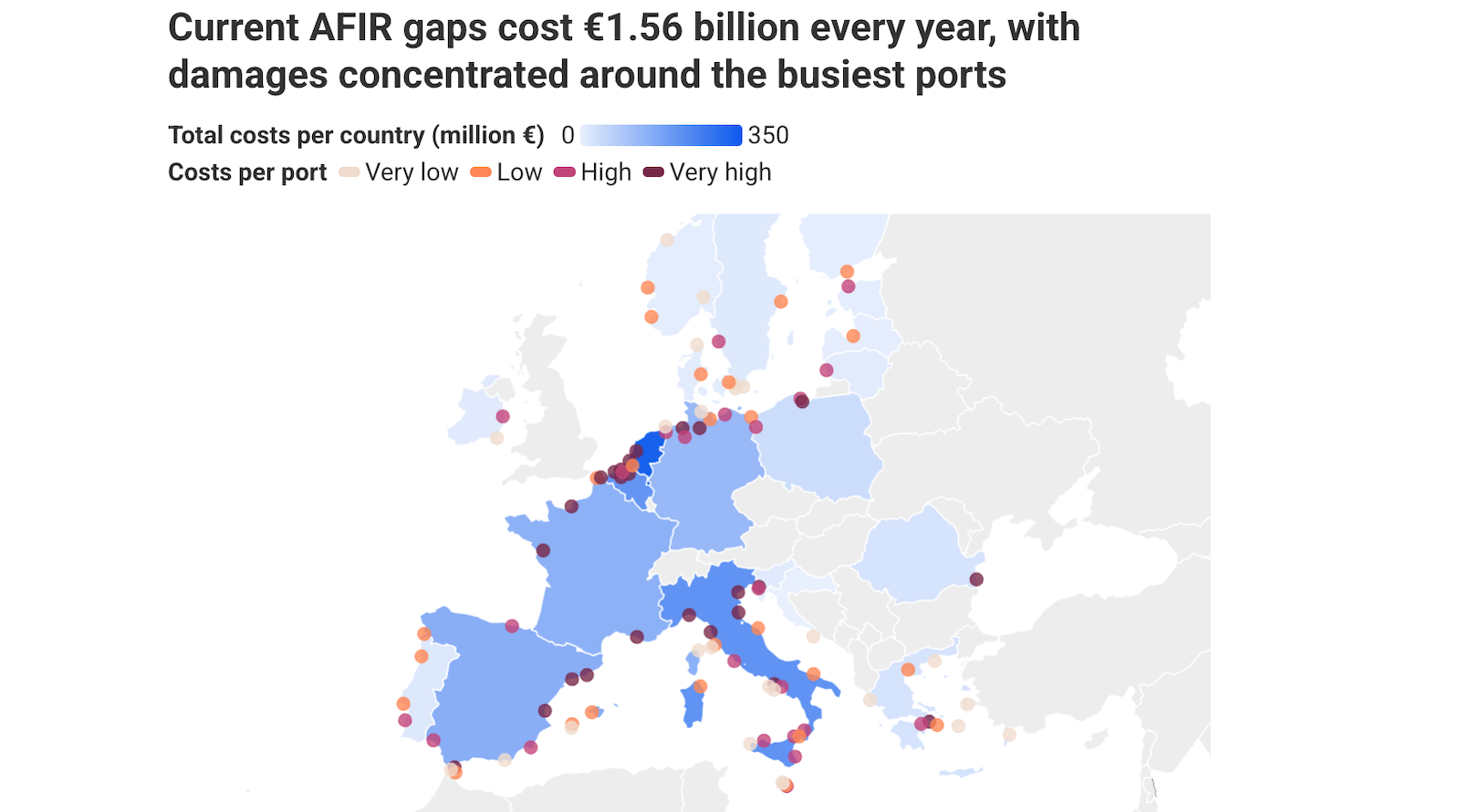
How current shore power rules cost hundreds of millions every year in health and climate damages.
Air pollution and climate emissions from ships at berth impose a heavy and unaddressed burden on European port communities and local economies. While the Alternative Fuels Infrastructure Regulation (AFIR) took an important first step by mandating Onshore Power Supply (OPS) for large container and passenger vessels, several blind spots leave over half of all in-port emissions unregulated.
To quantify the cost of inaction, we evaluated at-berth emissions across the 100 largest EU ports using CE Delft’s Handbook on the External Costs of Transport. Based on 2024 MRV data, in-port emissions cost €2.53 billion every year in health damages and climate abatement costs. Covering only the electricity demand from large unregulated ship types would already save €500 million annually, while tackling boilers would save another €714 million. Shipping companies effectively offload these costs onto public budgets, making fossil fuels appear artificially cheap. Once all impacts are counted, using electricity when at berth is half as expensive as burning fossil fuels.
While AFIR successfully kickstarted early shore power roll-out, its narrow scope leaves significant volumes of emissions unaddressed. Beyond health and climate impacts, this partial coverage creates uncertainty and deprives port authorities, network operators , and investors from the predictability they need to develop and deploy the required infrastructure. Providing a clear time horizon for the provision of shore power to all ships is essential to share infrastructure costs, reduce electricity prices and permanently clean up air in ports.
Source link





