
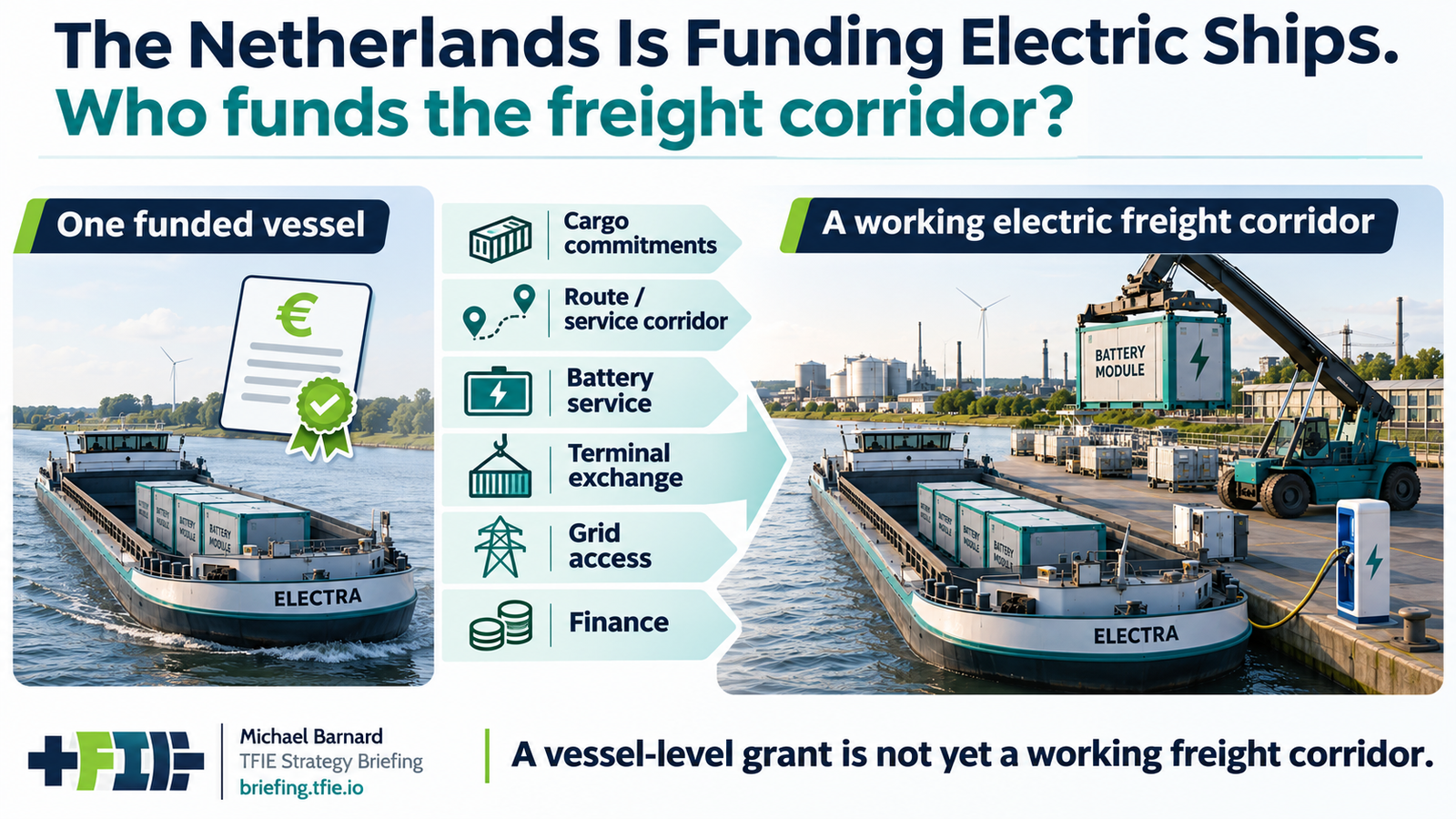
The Netherlands is preparing to spend €231.2 million over four years helping inland ships replace fossil-fuel propulsion. The first €36.93 million tender opens on November 17, 2026, and battery-electric vessels are among the eligible investments. This is a serious step toward decarbonizing freight on the waterways that link Dutch ports and Europe's industrial heartland. But the programme's most important scoring calculation rewards emissions avoided per euro of propulsion subsidy while excluding separate subsidies for the shore infrastructure on which the ship may depend. That distinction matters when the commercial product is a complete freight service, not an electric vessel sitting beside a quay.
The new Dutch tender is considerably more sophisticated than a technology demonstration fund, yet it leaves an important accounting boundary. My TFIE Strategy Briefing assessment follows that boundary from subsidized vessels to working routes, drawing on my open, 98-page Inland Freight Electrification report.
The RVO programme can support battery-electric systems, some hybrid arrangements and other propulsion technologies, together with eligible charging and refueling facilities. Its published explanation prioritizes electrification where practical. That is sensible: electric inland vessels are already operating in the Netherlands, and a subsidy should encourage the pathway that provides the required service at low emissions and acceptable cost.
The scheme also recognizes that a vessel does not operate in isolation. Applications receive points for commercial cooperation, cargo-owner agreements and the quality of supporting infrastructure arrangements. These are material criteria, not decorative promises. They are a welcome correction to programmes that fund novel equipment and assume the market, terminal and utility will somehow arrange everything else.
Source link