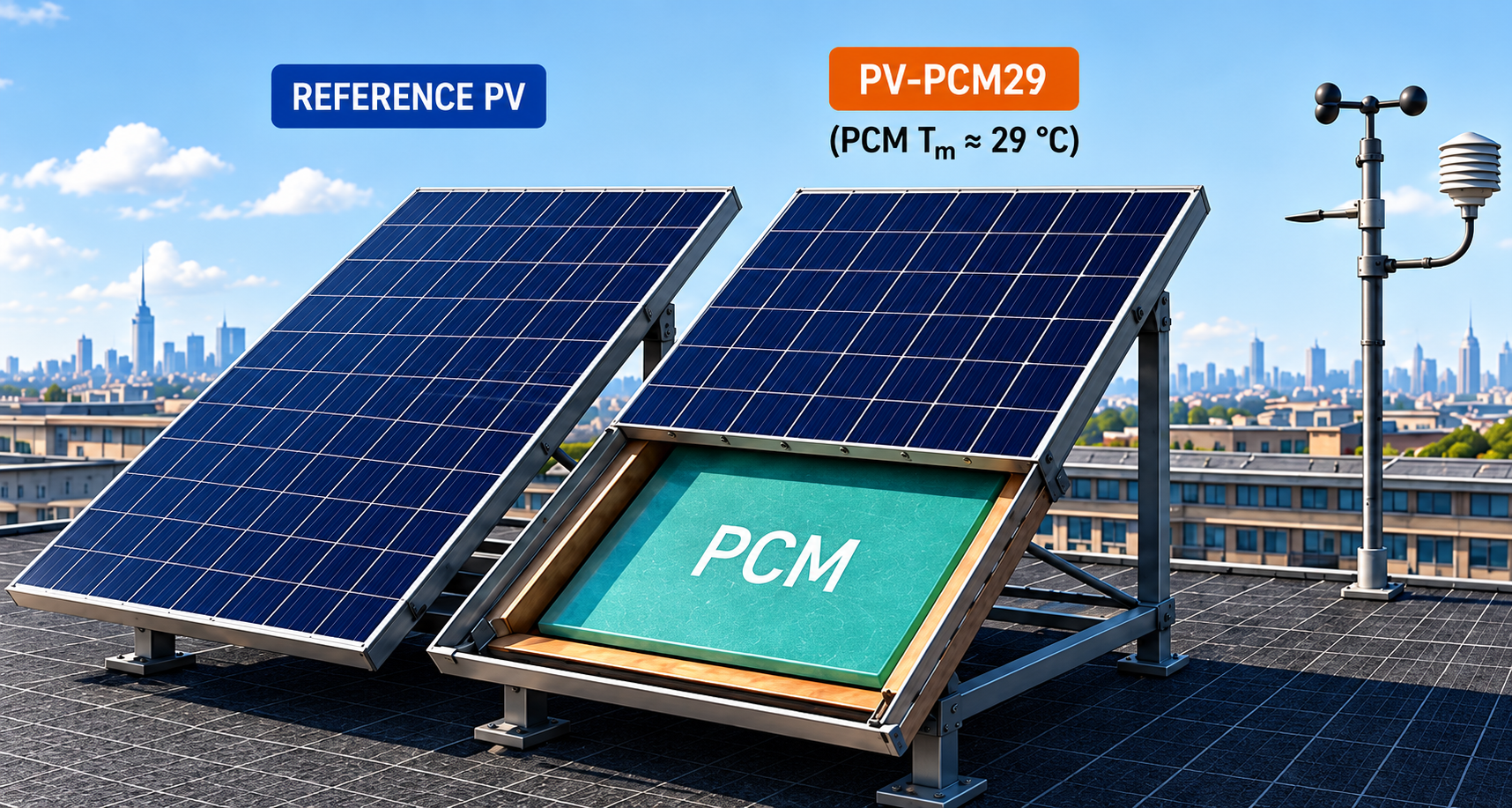
A research group at Italy’s Polytechnic University of Milan has studied rear-side heat transfer in PV modules equipped with a phase change material (PCM). The year-long experimental study focused on reconstructing and interpreting convective and infrared radiative heat transfer at the rear of the modules. The researchers aimed to determine how PCM integration affects rear-side heat exchange and assess its potential for improving PV module thermal management.
PCMs are substances that can absorb, store and release large amounts of latent heat as they undergo a change of physical state, such as melting and solidification. In PV applications, they are primarily investigated for passive thermal management. PCMs installed at the rear of a module absorb excess heat as temperatures rise, helping to limit module operating temperatures and potentially improve electrical performance. Previous pv magazine coverage has highlighted research into PCM-based PV cooling, multiple PCMs with different melting temperatures, and paraffin wax as a passive cooling material. PCMs can also act as thermal storage media, retaining excess heat from PV modules for later use.
“Our research moved beyond the usual assessment of PV-PCM systems in terms of temperature reduction or electrical performance and looked directly at the rear-side heat-transfer mechanisms,” corresponding author Domenico Mazzeo told pv magazine.
“We experimentally reconstructed and separated convection, long-wave infrared radiation and rear short-wave contributions over almost one year of outdoor operation,” he said.
Source link