
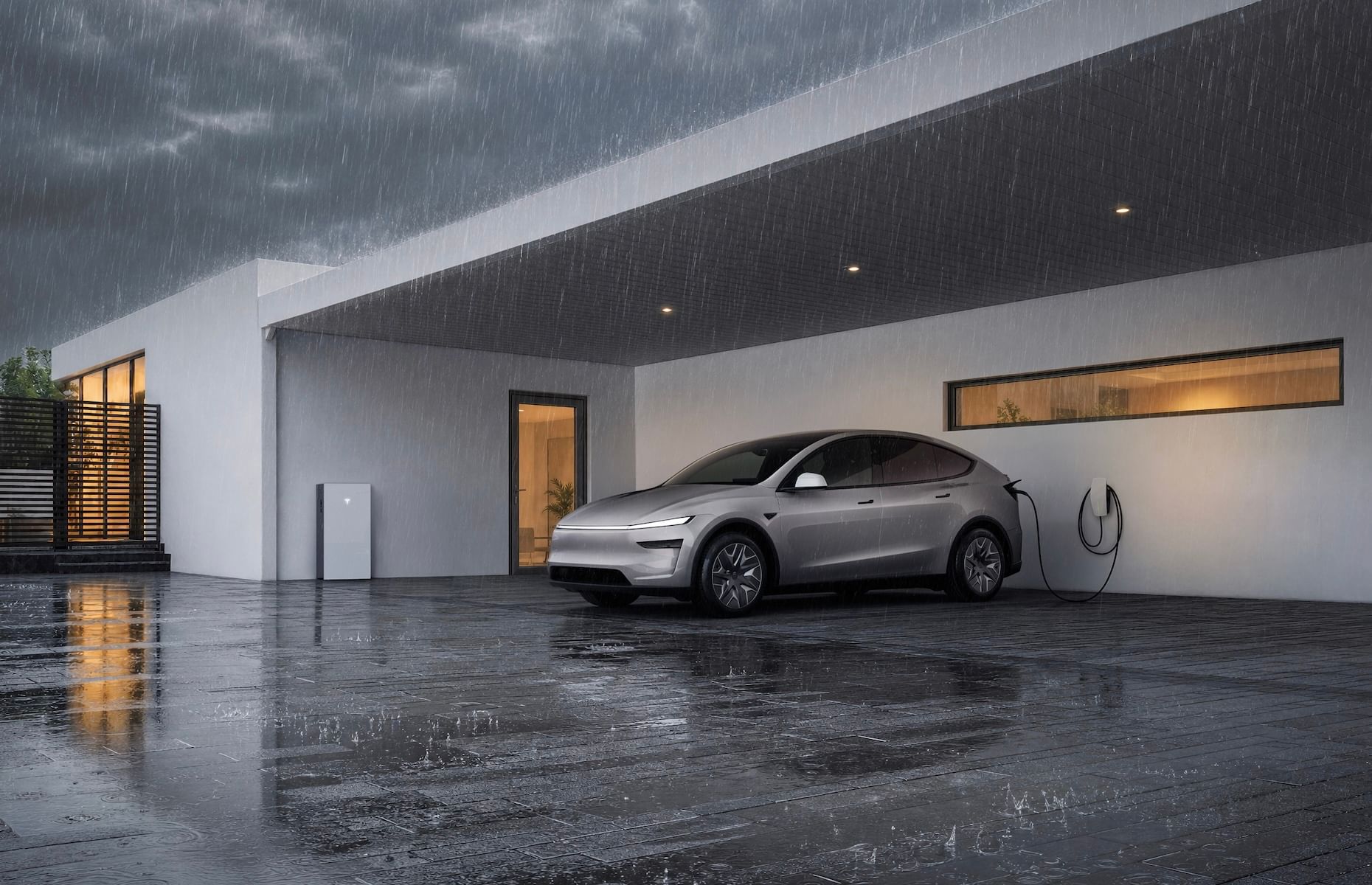
Households and the power grid run on alternating current. Batteries — including those in electric vehicles — run on direct current. That AC-DC divide has complicated the prospect of EVs as home backup batteries.
Today, almost every commercially available vehicle-to-home (V2H) backup power system in the U.S. requires a pricey DC bidirectional charger: a device that converts direct current from the vehicle to home-ready alternating current.
The only exception is Tesla’s. Over the past few years, the major EV and home battery manufacturer has been working out how to get its vehicles to do the job of sending AC power to homes and the grid. Tesla’s Cybertruck has had this ability for more than a year, and on Tuesday, the firm announced it is expanding the capability to its new Model 3 and Model Y EVs — as long as your home has a Powerwall 3 battery, that is.
“This is us bringing the whole ecosystem together and allowing our products to complement each other,” said Colby Hastings, head of Tesla Energy’s residential energy business. Instead of relying on a DC bidirectional charger to do the power conversion, AC bidirectional charging does the job with hardware in the vehicles themselves.
The Powerwall 3 retails for $ 8 , 200 and costs several thousand dollars more to install , but it’s a complete home backup system. The only additional equipment Tesla requires to add between two and three days of additional V 2 H backup power from an EV battery is its standard Wall Connector charger, which retails for $ 595 .
Source link





