This article has been reviewed according to Science X's editorial process and policies. Editors have highlighted the following attributes while ensuring the content's credibility:
A Korean research team has developed a transfer printing process that enables solid electrolytes, a key component of solid-state batteries, to be fabricated as very thin, uniform and defect-free layers over large areas. The technology is expected to provide a foundation for the large-area manufacturing of high-energy-density solid-state batteries.
A research team led by principal researcher Yongku Kang and senior researcher Myung-Soo Park at the Korea Research Institute of Chemical Technology (KRICT) developed a transfer printing technology using the garnet-type oxide solid electrolyte LLZTO, in which a solid electrolyte layer is first fabricated on a separate substrate and then transferred onto an electrode.
The study was published in Advanced Functional Materials in September 2026. Post-master's researcher Seul Gi Chu participated as the first author, while principal researcher Kang and senior researcher Park served as corresponding authors.
Solid-state batteries use solid electrolytes instead of liquid electrolytes, offering the potential to reduce fire risks and increase energy density. To achieve high energy density, the solid electrolyte must be thinner than 20 micrometers (µm) while maintaining uniform thickness over a large area.
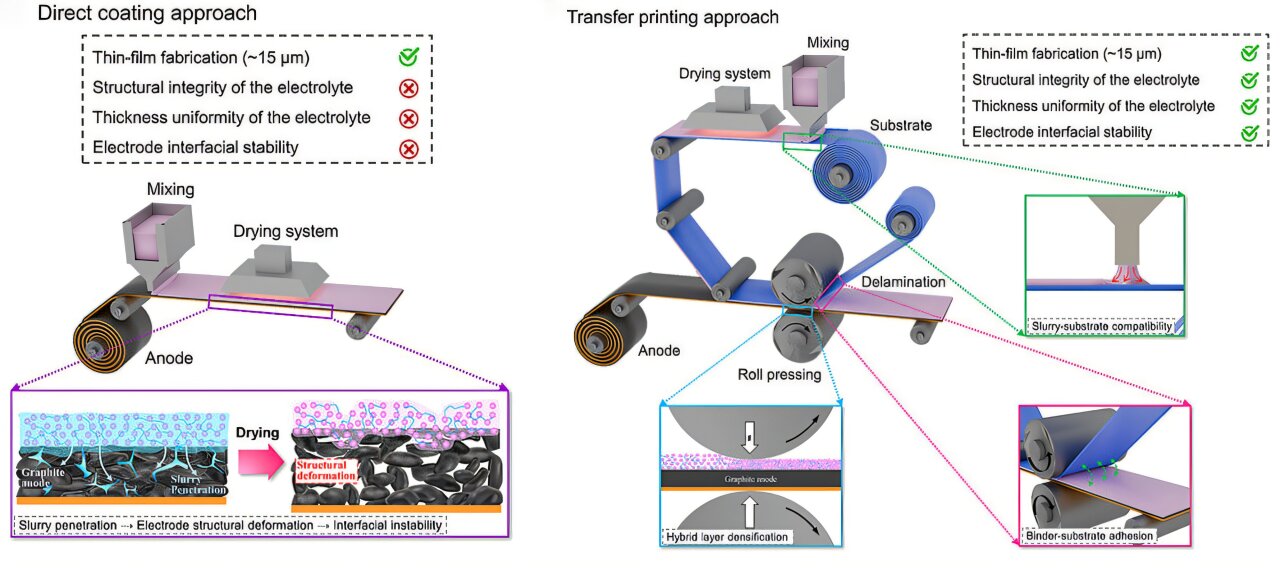
Conventional methods for fabricating solid electrolytes as freestanding films require thicknesses of 70–120 µm to prevent tearing. Directly coating an electrolyte slurry onto an electrode also presents problems because the liquid-state slurry can infiltrate the porous electrode, causing electrode deformation and nonuniform electrolyte thickness.
The research team applied a transfer printing method in which a solid electrolyte slurry is coated and dried on a PET-PDMS substrate, after which only the completed thin layer is pressure-laminated with a roller and transferred onto the electrode like a sticker.
Source link