
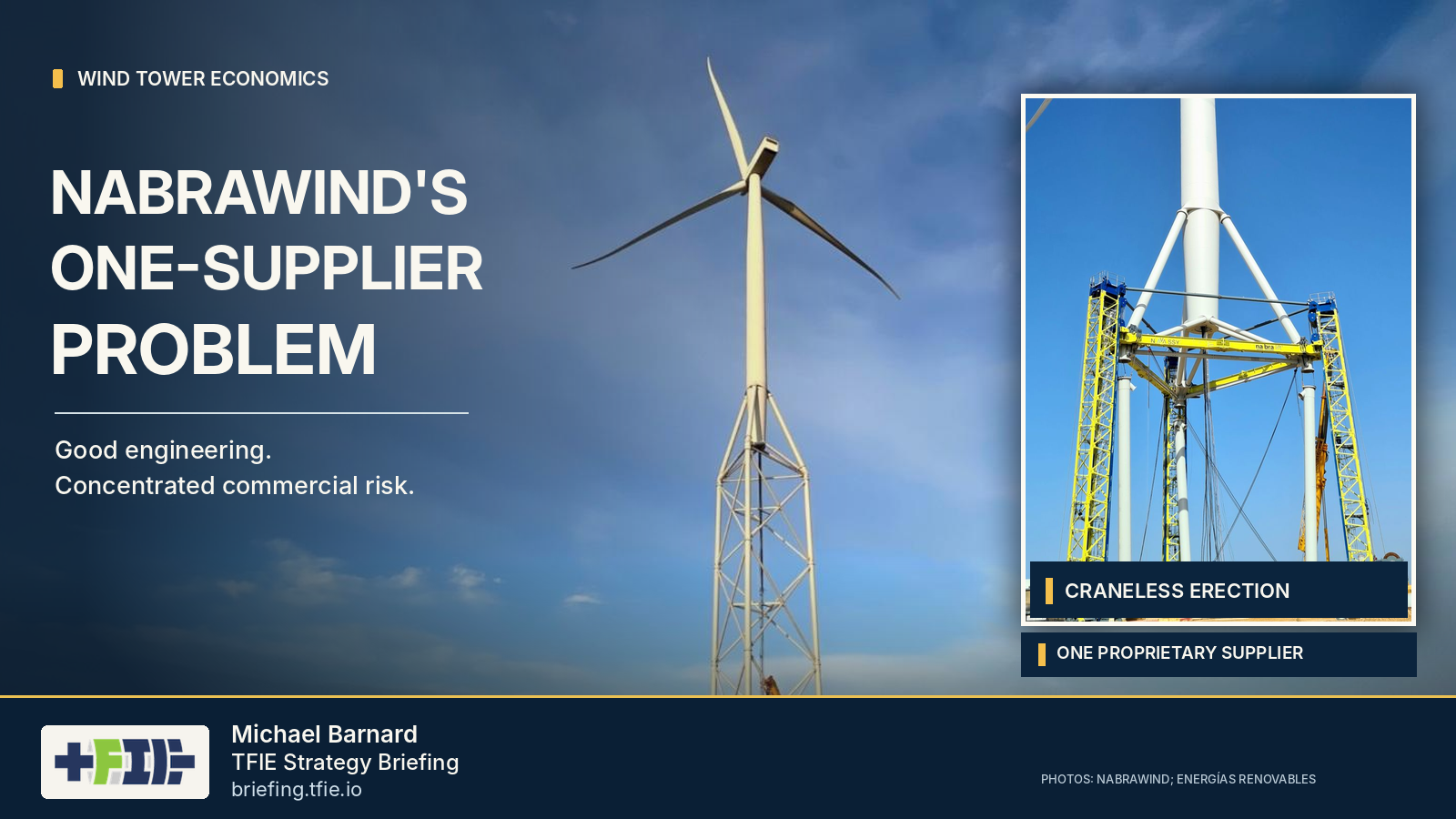
Spain’s Nabrawind has developed a way to install exceptionally tall wind turbine towers without bringing an enormous crawler crane to the site. Its Nabralift system uses a tubular upper tower supported by a three-legged steel structure. Hydraulic equipment raises the assembled turbine while modular sections are inserted below it near ground level. The lifting frame can then be removed and used on another installation. This addresses genuine logistical and construction problems, particularly at remote sites where specialist cranes are expensive to transport and where wind can interrupt conventional lifting operations.
The company has progressed beyond demonstration-scale hardware. In September 2026, UL Solutions issued type certification for Envision’s 7.8 MW turbine on Nabrawind’s 188-meter tower. Fortescue is using 17 of those tower configurations at the 133 MW Nullagine wind project in Western Australia’s Pilbara region, where construction is underway. Nabrawind previously erected a 160-meter prototype in Spain in under two weeks and has supplied smaller commercial towers in Morocco and France.
The engineering benefits are credible. Nabrawind reports using roughly 20% less tower steel than comparable conventional tubular designs and reducing foundation concrete by as much as 80%, depending on the design and site. Those are supplier claims rather than independently established savings across all wind farms. The potential to avoid large cranes, simplify transport and raise turbines in windier conditions could also matter substantially to total installed cost and construction schedules. High hub heights only earn their keep when those costs are justified by the electricity generated over the project’s life.
Source link