Researchers at Spain’s University of Burgos have developed and tested a full-size photovoltaic-thermal (PVT) collector featuring a heat-storage layer embedded behind the solar module. The layer combines paraffin, which stores heat as it melts, with expanded graphite (EG), which increases the paraffin’s thermal conductivity more than 30-fold.
“Previous experimental and numerical studies have demonstrated the potential of PCM and EG–PCM composites for thermal management and energy storage in PVT systems,” the researchers said. “However, the behavior of the present collector architecture – where EG–PCM tiles are placed directly between the PV module and the thermal absorber – has not been established.”
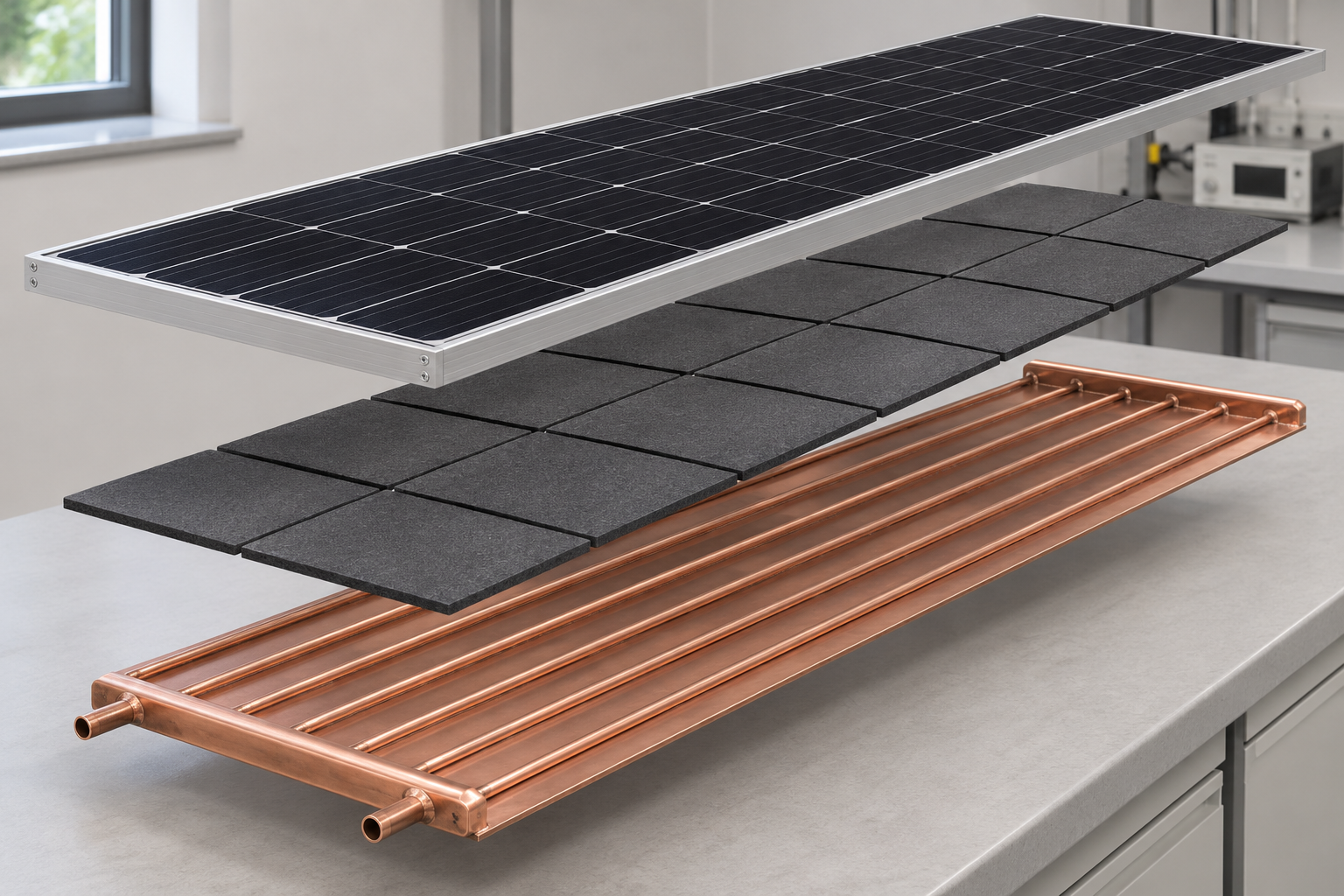
The researchers built the prototype using a commercial 200 W monocrystalline PERC module measuring 1,500 mm × 676 mm. They impregnated 18 expanded graphite tiles with Rubitherm RT44HC paraffin and arranged them in three columns and six rows across the rear of the module. The 20 mm-thick tiles weighed a total of 15.7 kg and contained 9% expanded graphite by mass.
The tiles were positioned directly between the module and a copper sheet-and-tube absorber. Neoprene strips applied pressure to maintain contact between the layers as the composite expanded and contracted, while extruded polystyrene provided rear insulation. For the glazed tests, the researchers added a 4 mm low-emissivity glass cover separated from the module by a 10 mm air gap.
The team tested the collector outdoors at the University of Burgos over four clear days in August and September 2025. In both glazed and unglazed configurations, they compared continuous fluid circulation with delayed circulation, which started when the composite reached a mean temperature of 44 C.
Source link