This article has been reviewed according to Science X's editorial process and policies. Editors have highlighted the following attributes while ensuring the content's credibility:
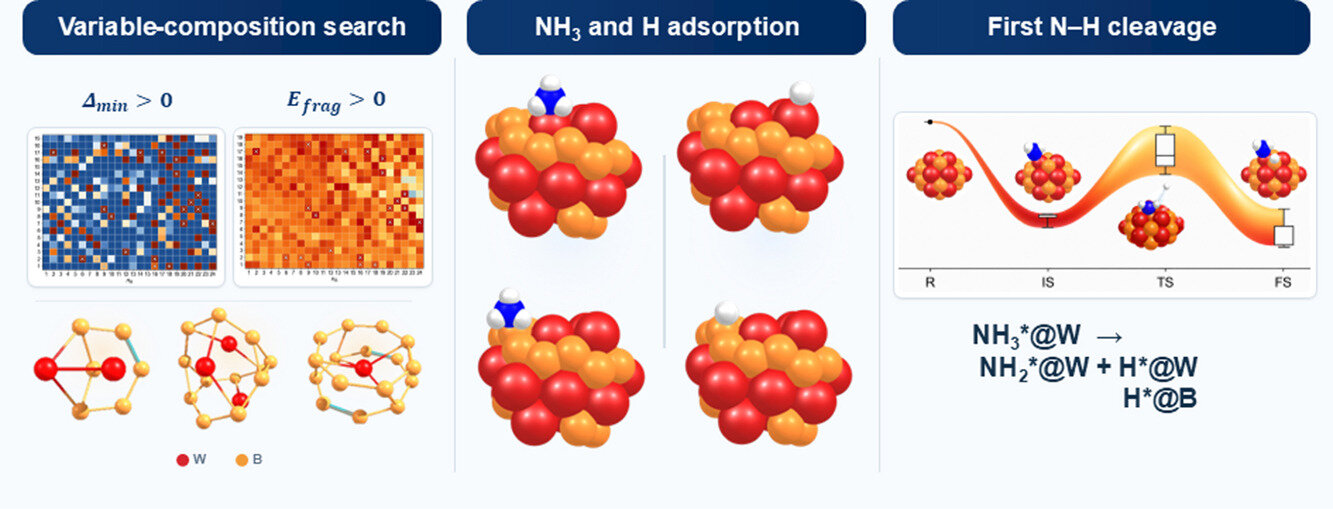
Researchers from Skoltech—a VEB.RF Group institution—have identified tungsten borides as promising catalysts for breaking ammonia down into hydrogen and nitrogen. This industrially important reaction is crucial for creating a flexible global market for clean hydrogen fuel: Pure hydrogen is costly to transport, while ammonia is easy to ship but expensive to extract hydrogen from. In computer simulations examining hydrogen cleavage from the ammonia molecule, tungsten boride nanoparticles showed promising catalytic characteristics comparable to those of the more expensive noble metals.
The study is published in the International Journal of Hydrogen Energy.
Hydrogen is a key piece of the decarbonization puzzle. Countries with abundant sunlight, wind or other renewable energy but limited local demand could use that cheap, clean power to split water into hydrogen and oxygen. Because hydrogen holds a great deal of chemical energy by weight and produces only water when burned or used in fuel cells, it could then be shipped abroad to power industry and transport or to balance energy grids. This would create a more flexible, tradable global market for clean energy.
But there is a major obstacle: Hydrogen gas is notoriously hard to handle at scale. Unless heavily compressed, it carries relatively little energy per unit of volume. Storing it requires either cryogenic liquefaction at minus 253 degrees Celsius (minus 423 degrees Fahrenheit) or extremely high-pressure tanks, and both are very expensive.
Source link