

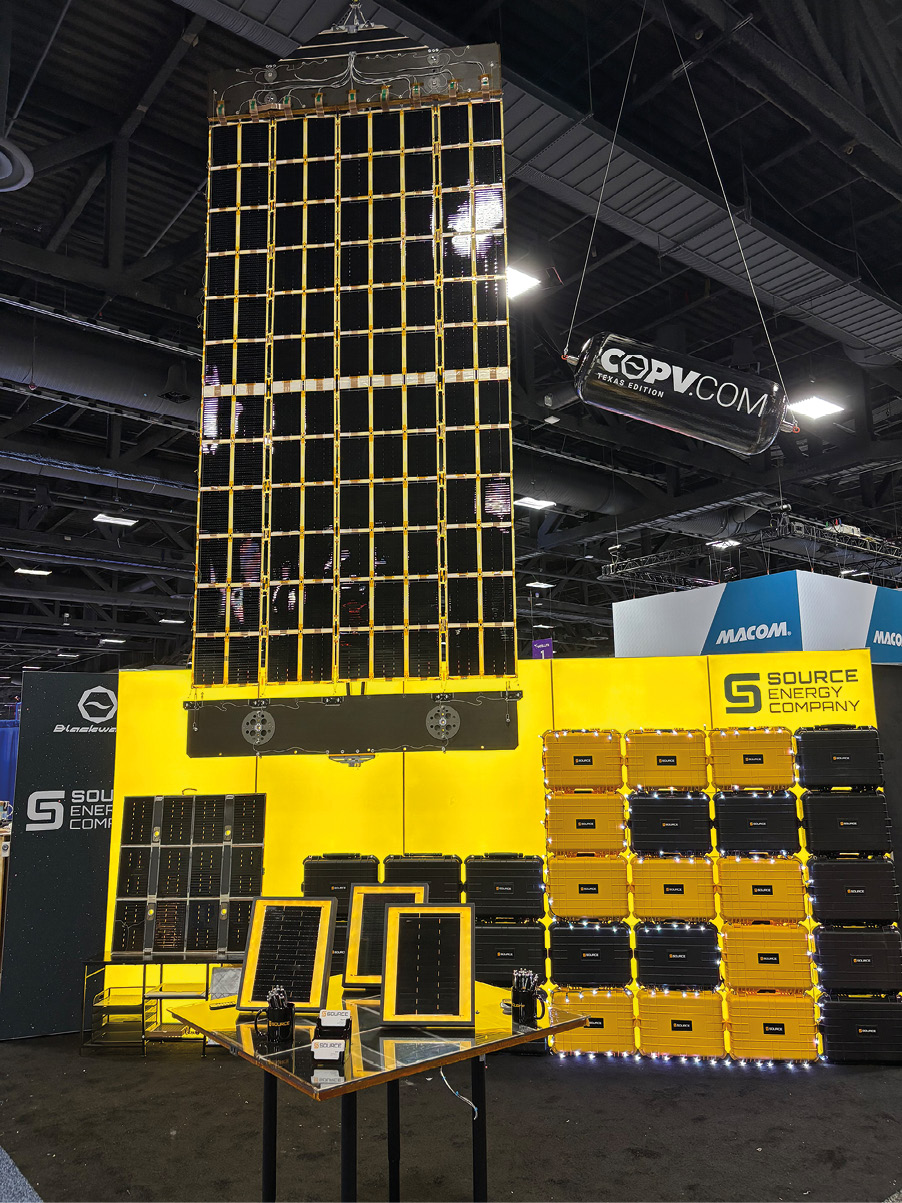
With excursions into space becoming more frequent, and the reasons behind them more commercial, the industry is exploring ways to generate electricity in space at lower cost and larger scale. And these requirements make ‘terrestrial’ silicon PV technology difficult to ignore.
US-based company Source Energy combines commercial silicon cells with a range of module technologies that “makes them suitable for a space environment,” explained Walter Magiera, VP Sales & Marketing at Source. The company has supplied modules to several spacecraft manufacturers, including Impulse Space’s LEO Express 1 that launched in November 2023.
It is now working to automate and scale up production at its base in Longmont, Colorado. Among the technologies it has implemented is the shingle-matrix stringer developed by Germany’s M10 Solar Technologies and Fraunhofer Institute for Solar Energy Systems (ISE). Fraunhofer ISE’s Najwa Abdel Latif noted that this technology, where cells are cut into strips and laid out in offset pattern, is particularly well suited to space applications thanks to its “resilience to localized physical damage from impacts by small objects in space, flexibility in layout, and tolerance to extreme temperature differences.”
The cell strips are interconnected and bonded using an adhesive, encapsulated between thin glass layers. The resulting product is a compact solar module measuring 321mm x 209mm and weighing 64 grams. Prototypes developed by Source and Fraunhofer ISE reached an average output of 15.6 W and 18.8% efficiency, measured based on outer space irradiance conditions (AM 0).
Magiera expects the production line in Colorado to be running at 10 MW annual capacity by the end of this year, increasing to 30 MW by mid-2027.
Source link





