
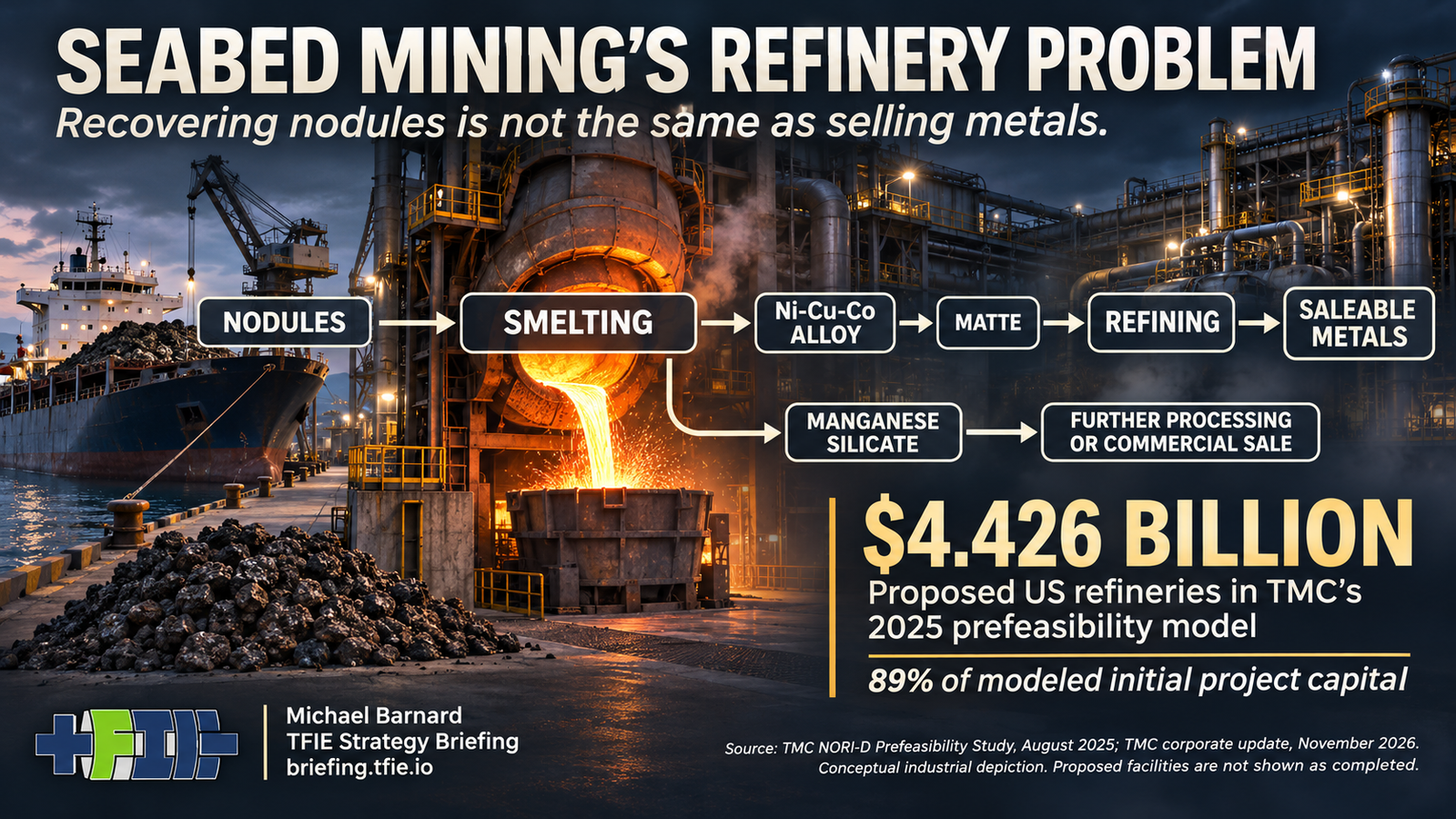
The Metals Company wants to recover polymetallic nodules from the seabed and sell the nickel, copper, cobalt and manganese they contain. That business needs an industrial processing system before its revenue projections become sales. TMC’s November 2026 update exposed the timing problem. Its proposed refinery complex in Brownsville, Texas, may not be operating when offshore collection begins. An established Japanese smelter operated by Pacific Metals, or PAMCO, is the prospective initial route, but it needs modifications to accept commercial volumes of nodules.
That gap belongs in the mining economics. TMC’s 2025 prefeasibility study allocated $4.426 billion to two proposed US hydrometallurgical refineries, about 89% of the study’s $4.971 billion of initial project capital. The denominator has a particular financing structure: the offshore amount covers the first collection system after an Allseas capital credit, while later systems are to be supplied through contracts and paid for through operating costs. The newer Brownsville proposal also has a different industrial scope. The 2025 figure shows the size of the processing business TMC’s economics must support, not a completed financing commitment for Brownsville.
Offshore collection gets the attention. Refineries decide what saleable material a collection system produces and who captures its value. A nodule delivered to port is a complex mineral feedstock, not a sale of four finished metals. One processing route smelts nodules into a nickel-copper-cobalt alloy and manganese silicate, converts the alloy into matte and refines the matte into marketable metals or chemicals. The manganese product needs customers or additional treatment. Each step consumes capital, energy, reagents, skilled labor and working capital.
Source link