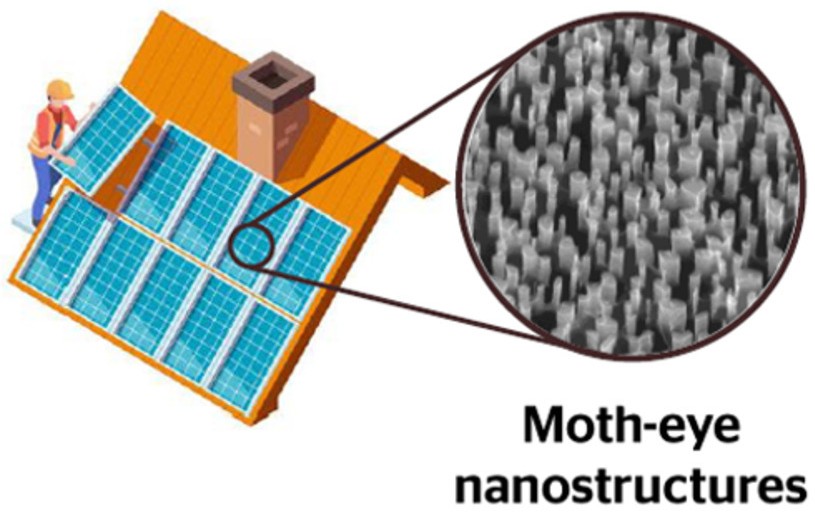
Researchers in Portugal have investigated the friction and wear behavior of moth-eye-inspired silicon surfaces designed to reduce light reflection and improve light absorption in solar cells. The study examined, in particular, how these antireflective nanostructures withstand mechanical stress relevant to solar module operation.
“If we want to integrate these nanostructures into the outer surfaces of photovoltaic modules, we also need to understand how they respond to mechanical contact, cleaning operations, and other environmental challenges,” corresponding author Vítor Lopes told pv magazine. “Rather than focusing only on optical performance, we investigated how these structures respond to friction and repeated mechanical loading, and how their morphology evolves as damage accumulates.”
Lopes said the team believes that applying a tribological perspective to light-management nanostructures is an important step toward understanding their durability and supporting their development for practical PV applications. “Coming from a mechanical engineering background and now working in photovoltaic research, I saw an opportunity to approach this problem from a different perspective,” he added.
The researchers fabricated moth-eye-inspired silicon surfaces measuring approximately 2.5 cm × 2.5 cm, with nanopillars averaging 434 nm in height and about 100 nm in diameter. They produced a silicon master mold through reactive ion etching, using gold nanoparticles formed by thermal dewetting as an etching mask. They then replicated the pattern onto an intermediate polymer stamp and imprinted it onto resist-coated silicon wafers using nanoimprint lithography, before transferring the pattern into the silicon through reactive ion etching.
5 N at a sliding speed of 5 mm/s for up to 50 cycles.
Source link