
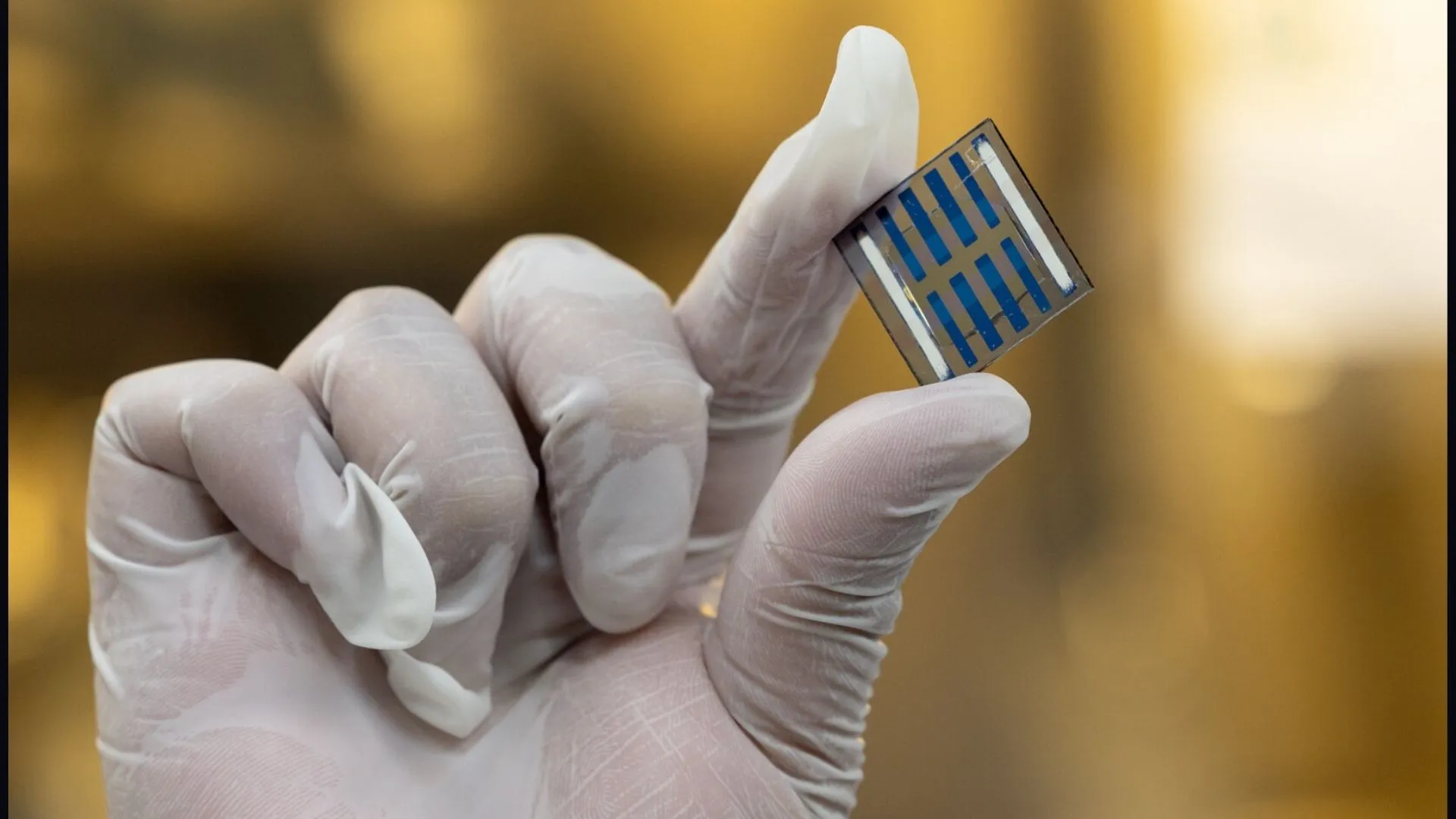
Solar cells could potentially generate more electricity by controlling not only how they absorb sunlight, but also the directions in which they emit light. Researchers at the Institute of Photonic Sciences (ICFO) in Barcelona have experimentally demonstrated a method for reducing one source of energy loss in solar cells by narrowing the angular range over which they emit photons.
The approach, published in Energy & Environmental Science, could offer a route to surpass the conventional theoretical efficiency limit for single-junction solar cells. The work focuses on a loss mechanism known as Boltzmann loss, which occurs because a material that absorbs light can also emit it.
A solar cell receives sunlight from a relatively narrow range of directions. The Sun occupies only a small area of the sky, meaning incoming sunlight reaches a solar cell within a narrow angular cone.
Photons generated inside the solar cell, however, can normally be emitted over a much wider range of directions. According to the ICFO researchers, this mismatch between the narrow incoming cone and broad emission cone reduces the amount of useful work that can ultimately be extracted from the device.
The researchers sought to reduce that loss by making the solar cell more selective about the directions in which it can emit light.
The team, led by ICFO and UPC Professor Jordi Martorell, included Dr. Francisco Bernal Texca, Chiara Cortese, Dr. Mariia Kramarenko and Dr. Quan Liu. They used an inverted organic solar cell based on the PM6:Y6 material blend and transformed it into an optical cavity.
Source link





