

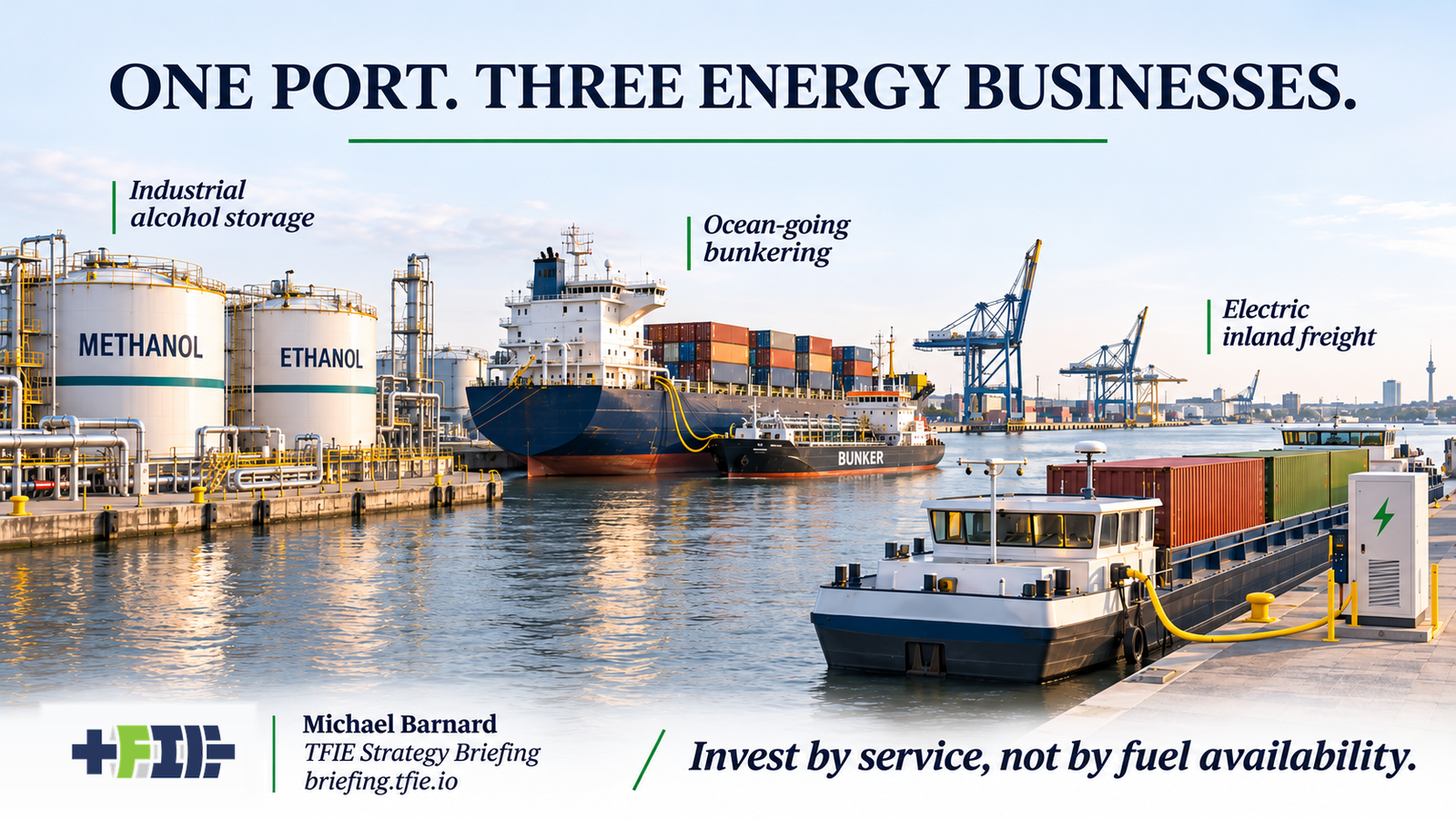
Rotterdam is expanding its methanol and ethanol business for industrial customers and ocean-going ships. Its inland freight fleet needs a different energy strategy. Confusing cargo, marine bunkering and propulsion would commit port authorities to parallel fuel networks when regular freight routes offer a stronger case for direct electrification.
In May 2026, Tankmatch’s inland bunker vessel MTS Experience delivered certified biomethanol and second-generation ethanol to X-Press Feeders’ ocean-going Eco Levant. The fuels were transferred separately and blended aboard the receiving ship into 90% methanol and 10% ethanol. It was Rotterdam’s first ethanol bunkering of a seagoing vessel. The receiving ship burned the alcohol blend. The inland barge delivered it as cargo. Those are two different businesses.
Rotterdam had already announced an expansion of Evos’s Europoort terminal. Five storage tanks totaling 67,500 m³ are planned for methanol and ethanol, along with an inland-shipping berth scheduled for completion in early 2028. The berth includes shore power for vessels alongside. The project expands industrial storage, cargo transshipment and marine bunkering capacity. Developing an electric inland-freight corridor requires a separate charging and battery-service plan.
Low-carbon alcohols have a role in shipping services that still need liquid fuel. Aviation competes for oils and fats suitable for renewable diesel, leaving other sustainable feedstocks for marine alcohol fuels. I reassessed biomethanol’s role in the residual liquid-fuel market and examined alcohol-fuel generators as range extenders for hybrid ships. The investment test is lifecycle emissions, delivered fuel cost and demand from ships that need liquid energy.
The five planned tanks add 67,500 m³ of storage capacity across several markets.
Source link





