This article has been reviewed according to Science X's editorial process and policies. Editors have highlighted the following attributes while ensuring the content's credibility:
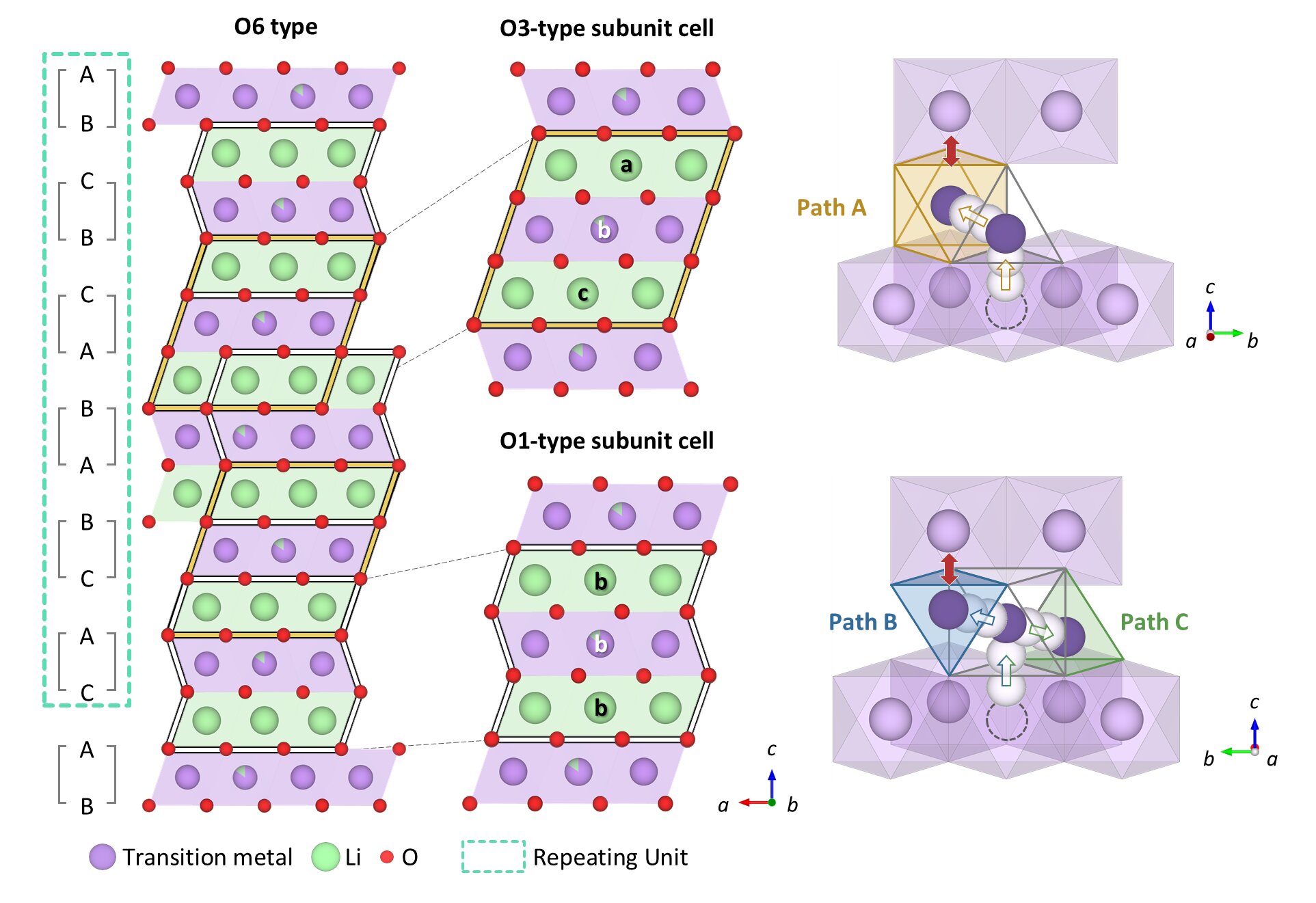
A new approach for designing cathode materials that could help enhance cycle performance has been proposed. A research team led by professor Kisuk Kang of the Department of Materials Science and Engineering at Seoul National University College of Engineering has identified a principle for suppressing voltage decay through the arrangement of atomic layers in cathode materials. Through experiments and simulations, the researchers found that an "O6 structure," which combines characteristics of different atomic arrangements, reduces structural evolution within the material during cycles.
Lithium-rich cathode materials have attracted attention as next-generation battery materials because they can store large amounts of energy. However, repeated charging and discharging can alter their structure, causing atoms to move away from their original positions. As these changes accumulate, the voltage at which the battery discharges electricity gradually decreases, reducing the amount of energy that can actually be used.
O6-type cathode materials with various compositions retained more than 98% of their initial average discharge voltage after 100 cycles, demonstrating better voltage retention than the O₃-type materials used for comparison. The findings are expected to contribute to the design of cathode materials that maintain high energy-storage capacity while reducing energy loss during repeated use.
Improving the performance of electric vehicles and energy storage systems requires cathode materials that can store large amounts of energy while withstanding repeated charging and discharging. Lithium-rich cathode materials contain some lithium even in layers primarily occupied by transition metals.
Source link