

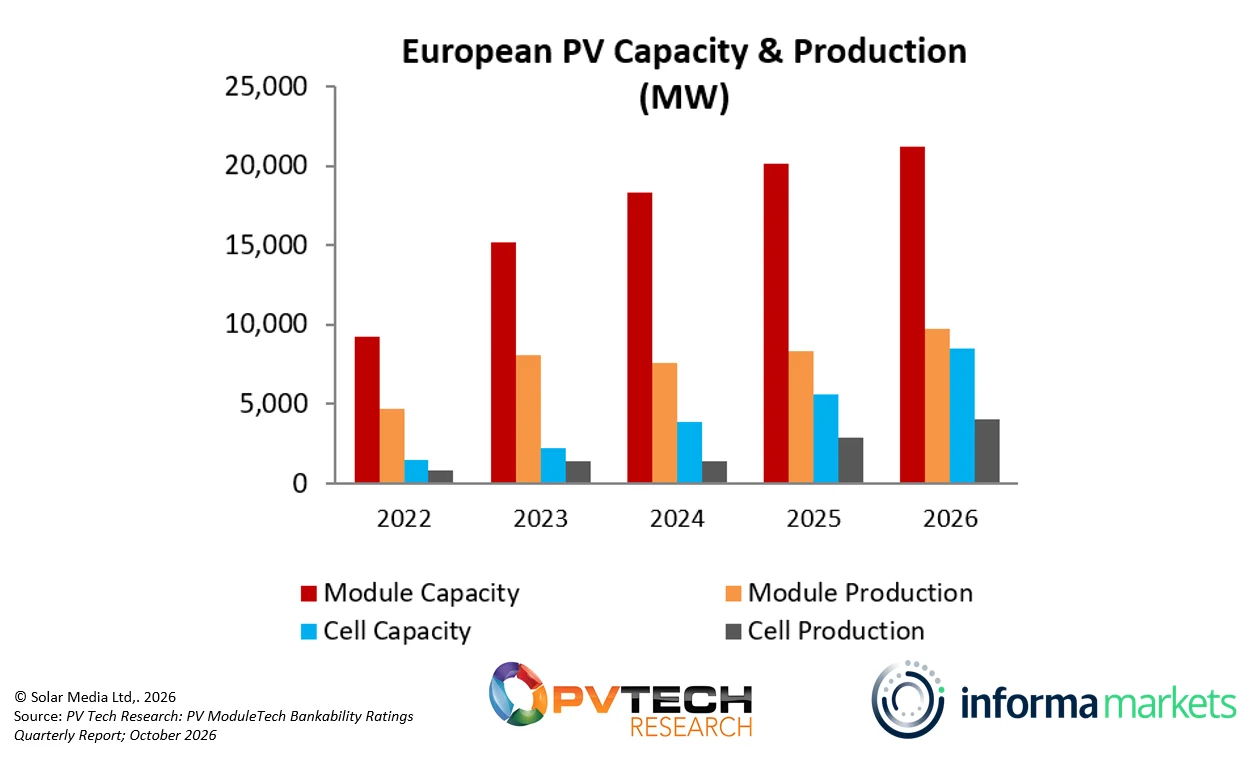
As module annual capacity doubled in the past four years, so did module production from less than 5GW to nearly 10GW by the end of 2026.
Both solar cell annual nameplate capacity and production are much lower than those of modules, but have grown faster over the past four years. Solar cell capacity grew by nearly sixfold between 2022 and 2026 to more than 8.5GW, while annual production is expected to reach 4GW this year, up from less than 1GW four years ago. Similar to what has happened in the US, there is an imbalance between the availability of solar cells and modules manufactured in Europe.
One of the notable announcements in European solar cell manufacturing made this year came from Turkish solar PV manufacturer Kalyon PV, which commissioned a 1.1GW solar cell processing line in its home country, increasing the company’s annual nameplate capacity for solar cells to 2.1GW.
European solar PV manufacturing growth in the past few years has primarily been driven by Turkish solar manufacturing, through the country’s High-Tech Turkiye Investment Incentive Programme (HIT-30), launched in 2024. The HIT-30 programme had a US$30 billion incentive from the government to support companies in several industries, including solar PV, to establish manufacturing capacity. Last year, five solar cell manufacturers, including Chinese-owned PV manufacturer Astronergy, unveiled plans to build solar cell capacity.
The upcoming PV ModuleTech Europe Conference in Málaga, Spain, on 3-4 November 2026, will cover the European solar market with a focus on procurement and performance of utility-scale solar plants.
Source link





