
This article has been reviewed according to Science X's editorial process and policies. Editors have highlighted the following attributes while ensuring the content's credibility:
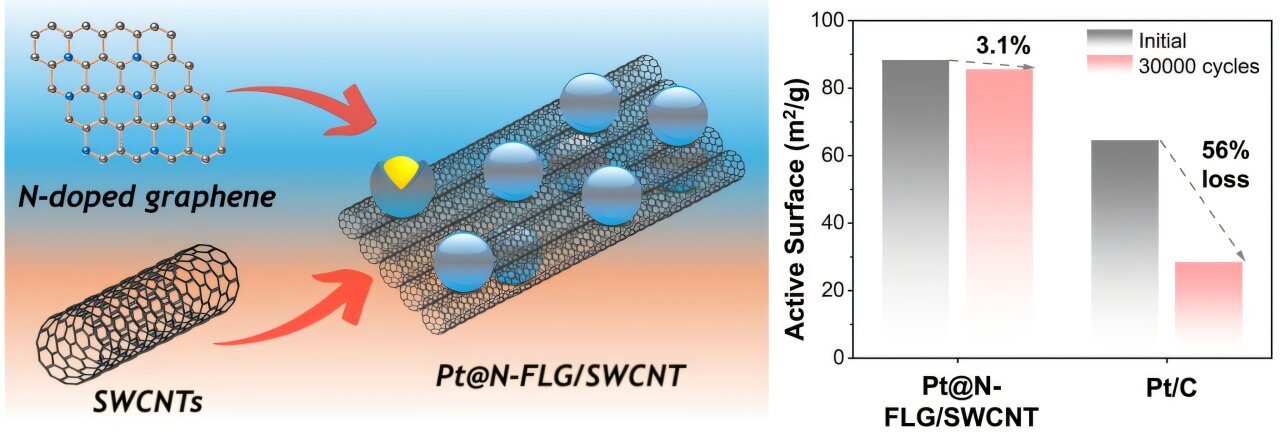
Researchers from Nagoya University in Japan have developed a durable fuel-cell catalyst by wrapping platinum nanoparticles in nitrogen-containing graphene and placing them on carbon nanotubes. This design retained 96.9% of its active surface after 30,000 durability cycles, pointing towards fuel cells with longer lifespans and lower platinum demand.
Fuel cells turn the chemical energy of hydrogen directly into electricity. Hydrogen is fed to one side of the cell, where it separates into protons and electrons. The electrons travel through an external circuit to provide power, while the protons cross a membrane. On the other side, they reunite with the electrons and oxygen from the air, producing water.
Water is the only byproduct here; no carbon dioxide is emitted at any point during this process. This makes fuel cells promising sources of clean energy that can be used to power vehicles and other applications. Fuel cells are particularly useful for heavy-duty vehicles and public transit, which would otherwise require much larger conventional EV batteries.
However, broader commercial use of fuel cells is limited by cost. The reaction between oxygen, protons and electrons is slow. To speed it up, platinum, a scarce and expensive precious metal, is used as a catalyst.
To reduce costs, research into fuel cell catalyst technology is currently targeting two fronts: improving performance and durability. "Durability is a critical problem, especially for use in heavy-duty vehicles," said Miftakhul Huda, a designated lecturer working in the Matsuo Lab at Nagoya University's Department of Chemical Systems Engineering and a lead investigator of this study along with professor Yutaka Matsuo.
Source link





