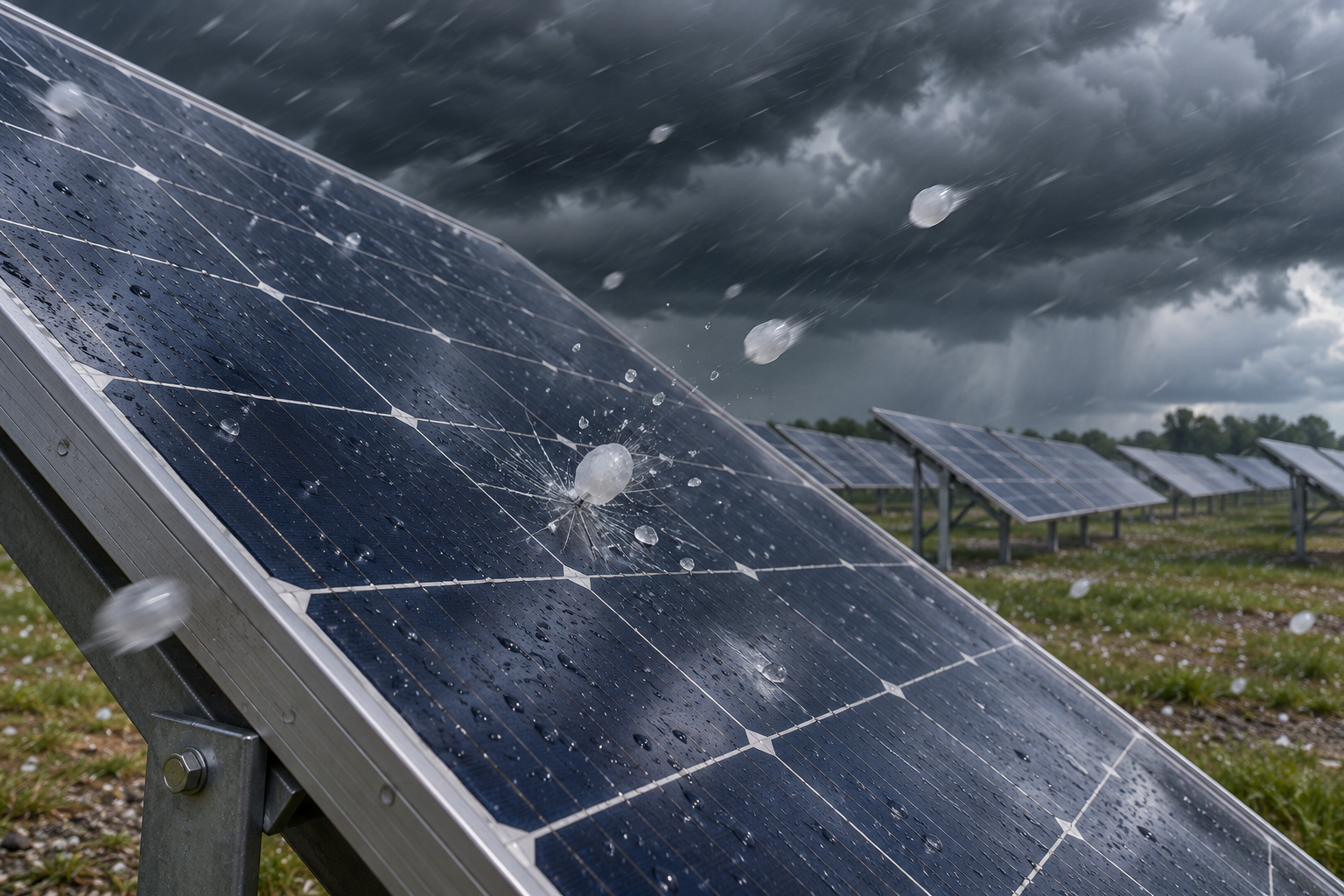
Researchers in Iran have developed a computational model to predict hailstone trajectories and impact severity on PV modules under different wind conditions and panel tilt angles. The model accounts for wind speed, wind direction, and hailstone aerodynamics to assess potential mechanical damage to solar panels.
“We considered the combined effects of wind speed, wind direction, hailstone aerodynamic behavior, and photovoltaic panel tilt angle,” corresponding author Armin Hasanpour told pv magazine. “The trajectories were calculated by considering gravitational and aerodynamic forces and solving the governing equations using the fourth-order Runge–Kutta method.”
Hasanpour said the team aimed to develop mathematical relationships and numerical tools to predict potential hailstorm damage.
“Such quantitative approaches could eventually contribute to photovoltaic hail-risk databases used by insurance companies, support policymakers in assessing climate-related risks, and help designers determine more appropriate panel tilt angles based on local meteorological conditions,” he said.
The researchers used a 3 MW solar project in Takestan, Iran, as a case study, drawing on regional weather records from 2004 to 2024 to characterize local conditions. They developed a numerical model to simulate spherical hailstones with diameters ranging from 1 cm to 10 cm under wind speeds of 1 m/s to 50 m/s, assuming constant air and ice densities and an initial release height of 2,000 m.
The model incorporated gravitational forces and aerodynamic drag, with the governing equations solved using the fourth-order Runge–Kutta method. The researchers compared simulations using constant drag coefficients with those using Reynolds-number-dependent coefficients.
They projected the calculated impact velocities onto the direction normal to the panel surface to determine the perpendicular component of kinetic energy.
Source link