This article has been reviewed according to Science X's editorial process and policies. Editors have highlighted the following attributes while ensuring the content's credibility:
The start of a new battery materials library could pave the way for future AI models to help scientists design sodium-ion batteries that charge faster, last longer and store more energy, according to new research from the University of Surrey.
Sodium-ion batteries are being developed as a promising alternative to conventional lithium-ion batteries, as sodium is much more abundant and widely available. However, improving the amount of energy they can hold and how well they perform over repeated charging is a major barrier to their wider use.
In a new study published in the Journal of Materials Chemistry A, researchers investigated how changing the chemical makeup of sodium manganese oxide could improve its performance as a cathode—a key battery component that helps determine how much energy a battery can store and how well it performs.
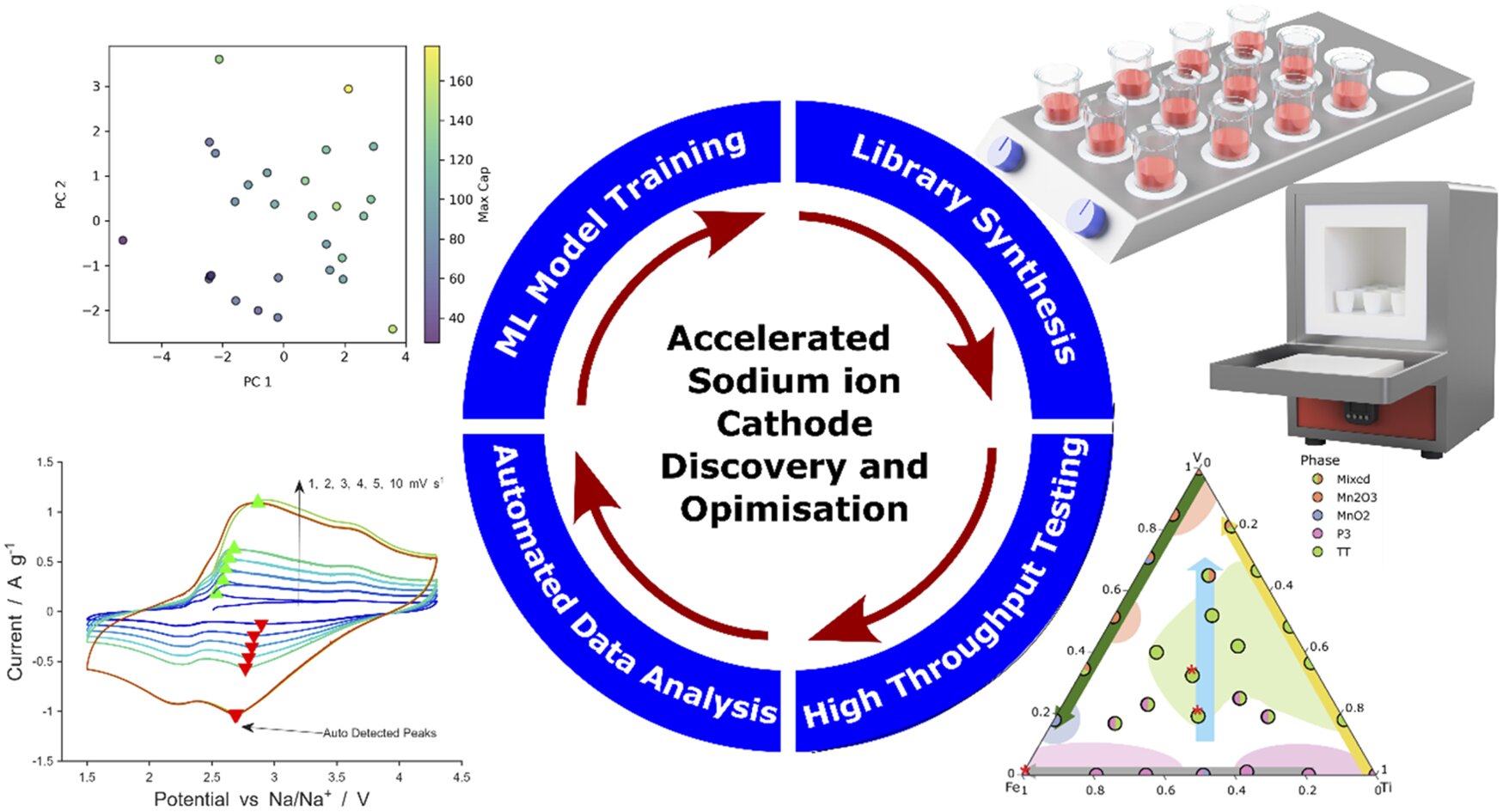
The team created a library of 28 different compositions, substituting some of the manganese with varying amounts of iron, titanium and vanadium, before comparing how each performed when tested in sodium-ion batteries.
The results showed that iron was linked to higher energy-storage capacity, vanadium improved stability over repeated charging and discharging, and small amounts of titanium improved performance at higher rates. Some titanium-containing compositions also retained more than 90% of their capacity after 100 cycles.
An automated approach was developed to analyze the large amounts of data generated by the experiments, with the resulting data set used to train a machine-learning model.
Source link