
This article has been reviewed according to Science X's editorial process and policies. Editors have highlighted the following attributes while ensuring the content's credibility:
All-solid-state lithium batteries using nonflammable solid electrolytes are widely recognized as promising candidates for next-generation energy storage because of their superior safety and fast-charging capability. However, widely studied oxide-based solid electrolytes contain heavy elements such as lanthanum and zirconium, resulting in high densities (e.g., 5.12 g/cm3) that limit improvements in overall battery gravimetric energy density.
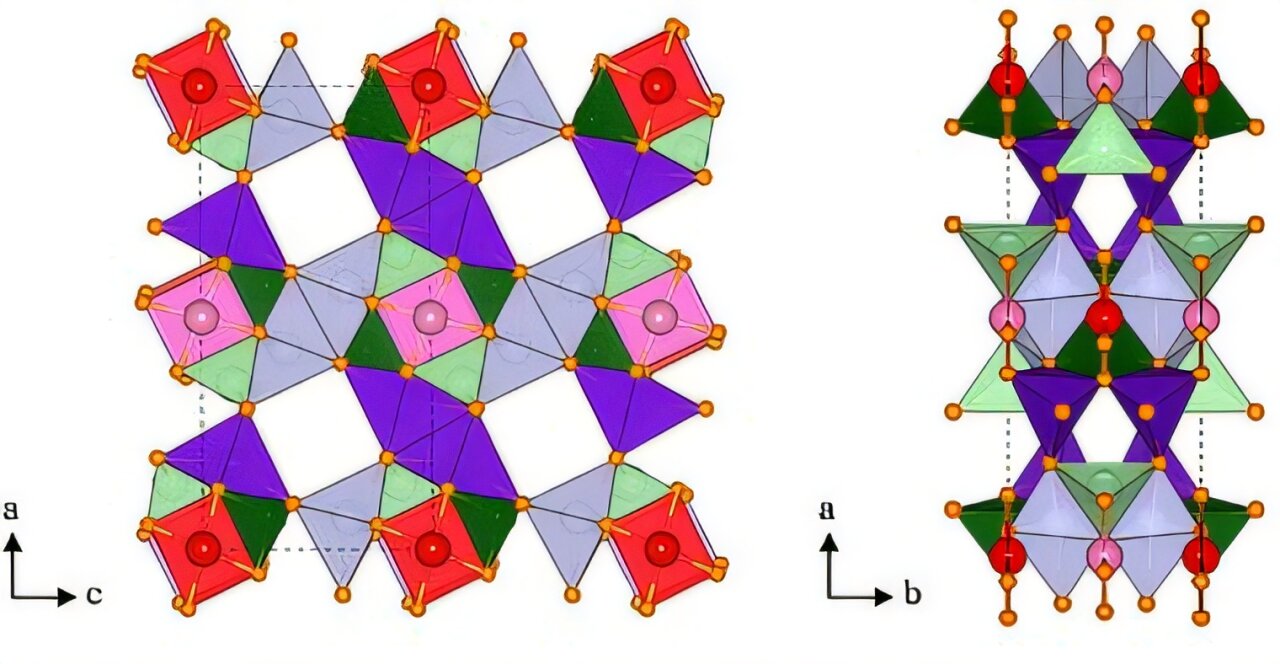
To address this weight challenge, a joint research team led by Nichia Corporation and The University of Electro-Communications (UEC Tokyo) investigated a new solid electrolyte framework composed predominantly of light elements: RbLi(Li3SiO4)2. With a low theoretical density of 2.74 g/cm3, this material adopts a monoclinic UCr4C4-type crystal structure featuring one-dimensional lithium channels.
Combining experimental synthesis with advanced computational simulations—including preferred potential molecular dynamics (PFP-MD) and density functional theory (DFT) calculations—the team uncovered key insights into its ion conduction mechanism:
Although the framework originates from one-dimensional channels along the b-axis, simulations revealed that these channels interconnect to form a three-dimensional lithium transport network. This structure prevents conduction bottlenecks caused by localized crystal defects.
30 eV. 26 eV).
Source link





