
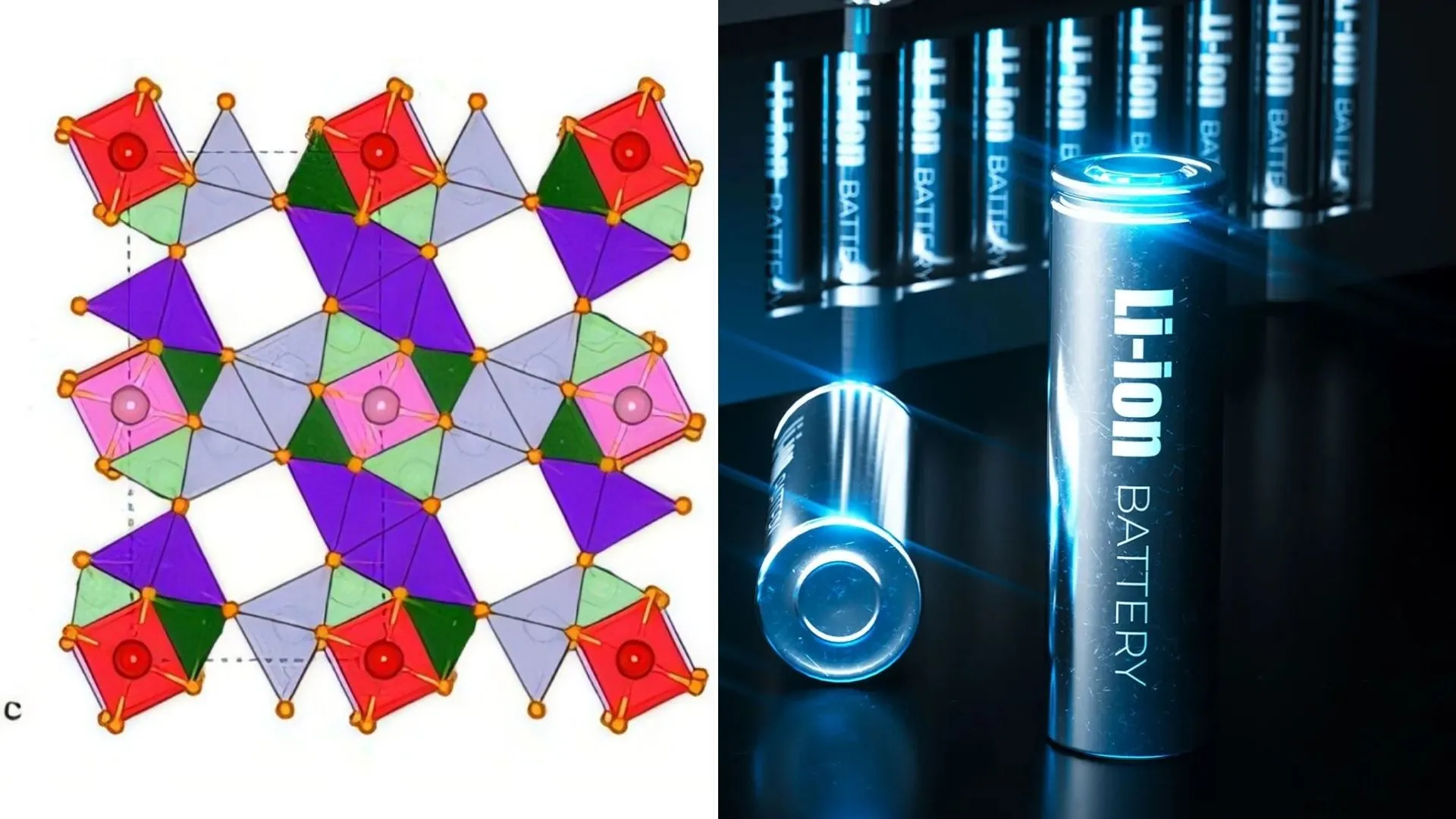
A newly identified crystal framework could help address a key challenge facing all-solid-state lithium batteries: increasing energy density without adding weight.
Researchers from the University of Electro-Communications (UEC Tokyo) and Nichia Corporation have investigated a solid electrolyte made primarily from relatively light elements. The material, RbLi(Li₃SiO₄)₂, has a theoretical density of 2.74 grams per cubic centimeter, considerably lower than the 5.12 g/cm³ density cited for some widely studied oxide solid electrolytes containing heavier elements such as lanthanum and zirconium.
The researchers found that the material’s crystal structure can support rapid lithium-ion movement through a three-dimensional transport network. However, the team also identified a bottleneck that currently limits conduction in stoichiometric samples, pointing to a possible route for improve the material by changing its composition.
All-solid-state lithium batteries replace the flammable liquid electrolyte found in conventional lithium-ion batteries with a solid electrolyte. This can improve safety while potentially enabling fast charging and higher-performance battery designs.
The weight of the solid electrolyte itself, however, can affect a battery’s gravimetric energy density and the amount of energy it can store relative to its mass. The researchers therefore turned to the UCr₄C₄-type crystal framework of RbLi(Li₃SiO₄)₂. The material has a monoclinic crystal structure and a theoretical density of 2.74 g/cm³.
At first glance, the framework appears to provide one-dimensional pathways for lithium ions along one crystallographic direction. Computational simulations, however, showed that these channels connect with one another, creating a three-dimensional network through which lithium ions can move. That interconnected structure could help prevent localized crystal defects from completely blocking ion transport.
Source link





