Researchers from China have compared the life‑cycle economic performance of thermal energy storage (TES) and heat pumps (HP) for industrial heating applications under negative price conditions.
“To our knowledge, prior techno-economic comparisons between heat pumps and thermal energy storage for industrial heating mostly focused on conventional time-of-use electricity tariffs, without systematically quantifying their full-life-cycle competitiveness under negative-price market conditions driven by high renewable penetration,” said corresponding author Zijian Liu to pv magazine. “Our work fills this gap.”
Liu further explained that his team built a two-layer co-optimization framework covering both system sizing and hourly dispatch, explicitly incorporating two core characteristics of negative prices: price depth and occurrence probability. “We further generated quantitative decision maps for three typical industrial heating scenarios: hot-water, low-pressure steam, and high-pressure steam,” he added.
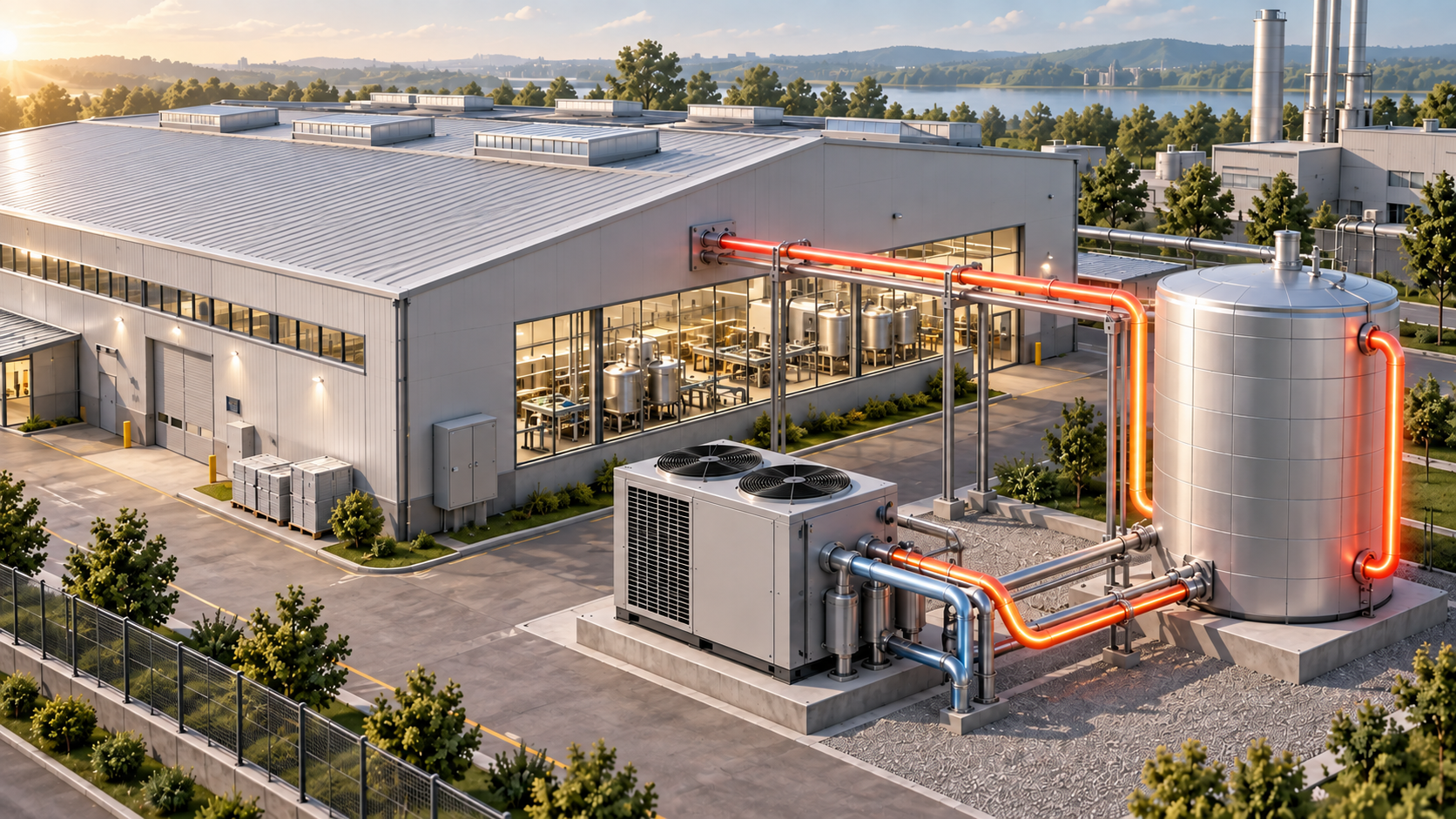
More specifically, the researchers modeled a factory with a constant heating demand and compared a heat pump that supplies heat directly with an electric heater that can either supply heat directly or charge a hot-water storage tank for later use. They also modeled a system using both technologies, allowing the amount of heat supplied by each to vary hour by hour. The three applications were hot water at 60 C, low-pressure steam at 130 C, and high-pressure steam at 180 C.
Using an industrial tariff from China’s Shandong province as the baseline for normal hours, the team modeled negative prices occurring during daytime hours and varied both their frequency and depth. 20 yuan/kWh during 25%. The researchers also varied the systems’ relative upfront costs and compared their annualized investment and operating costs over a 20-year lifetime.
Source link