This article has been reviewed according to Science X's editorial process and policies. Editors have highlighted the following attributes while ensuring the content's credibility:
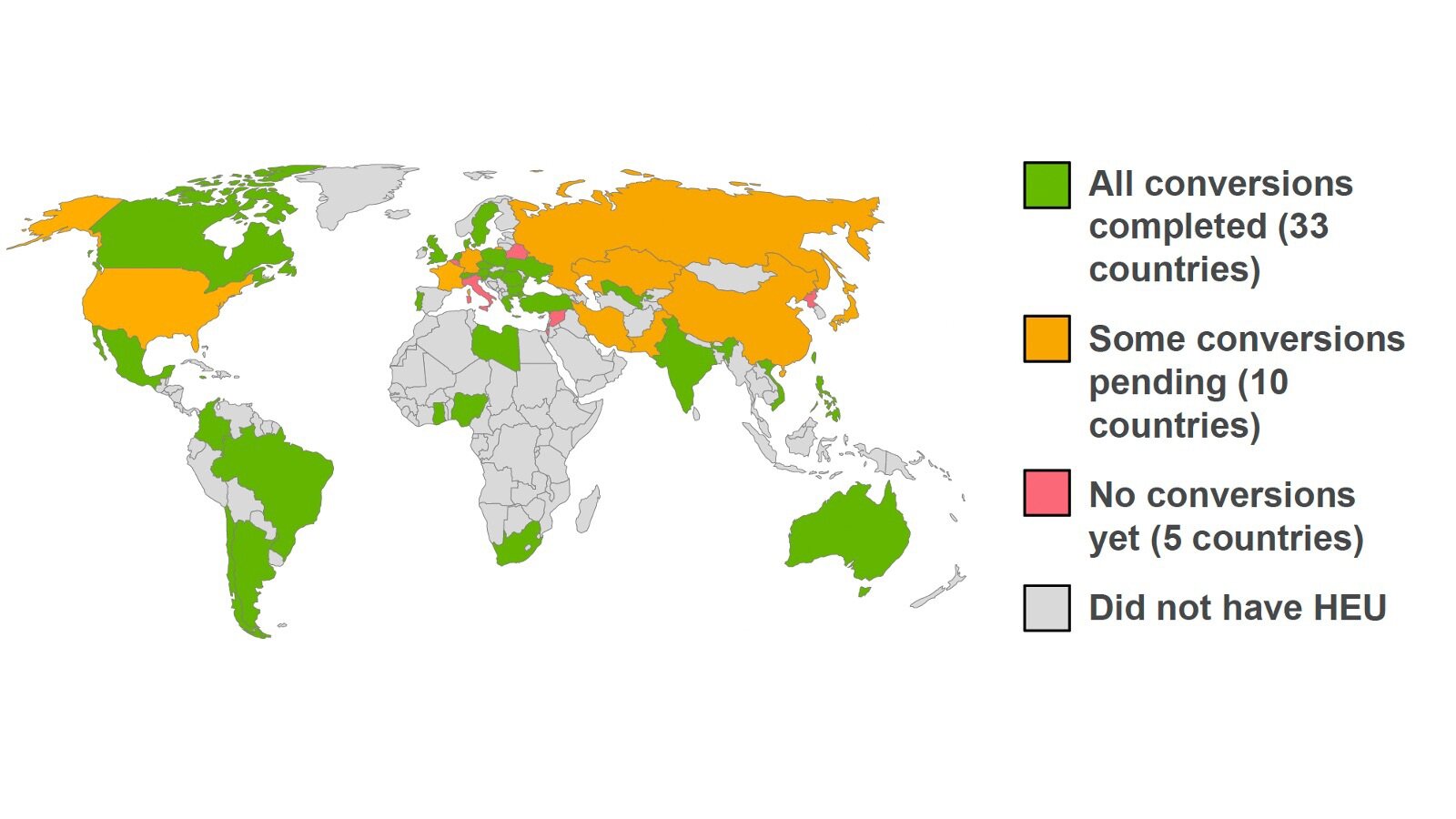
For decades, nonproliferation scientists and engineers at the U.S. Department of Energy's Argonne National Laboratory have helped convert the fuel in dozens of research reactors around the world so they can operate safely and more securely. They find ways to change systems that rely on highly enriched uranium fuel, which can be used to make weapons, to systems that use low-enriched uranium fuel. With every fuel conversion, Argonne has gained experience, insight and a reputation for expertise in solving some of the toughest reactor conversion problems.
Now, Argonne has helped researchers in Belgium achieve a significant technical milestone in what might be its most involved effort to date. Argonne scientists and engineers helped demonstrate safety metrics needed by Belgium's nuclear regulators to approve the fuel conversion in the BR2 research reactor at Belgium's nuclear research center, SCK CEN.
The BR2 research reactor is one of Europe's most complex and one of its most important because it is a leading materials testing reactor and producer of medical isotopes and semiconductor materials. By working together, the American and Belgian experts are helping to secure these capabilities while lowering the risk of anyone diverting the research reactor's fuel to make weapons.
The BR2 reactor is responsible for producing about one-fourth of the world's supply of molybdenum-99, an isotope that decays into technetium-99m. Technetium-99m is widely used to diagnose a range of health conditions, including heart disease and cancer.
Source link