This article has been reviewed according to Science X's editorial process and policies. Editors have highlighted the following attributes while ensuring the content's credibility:
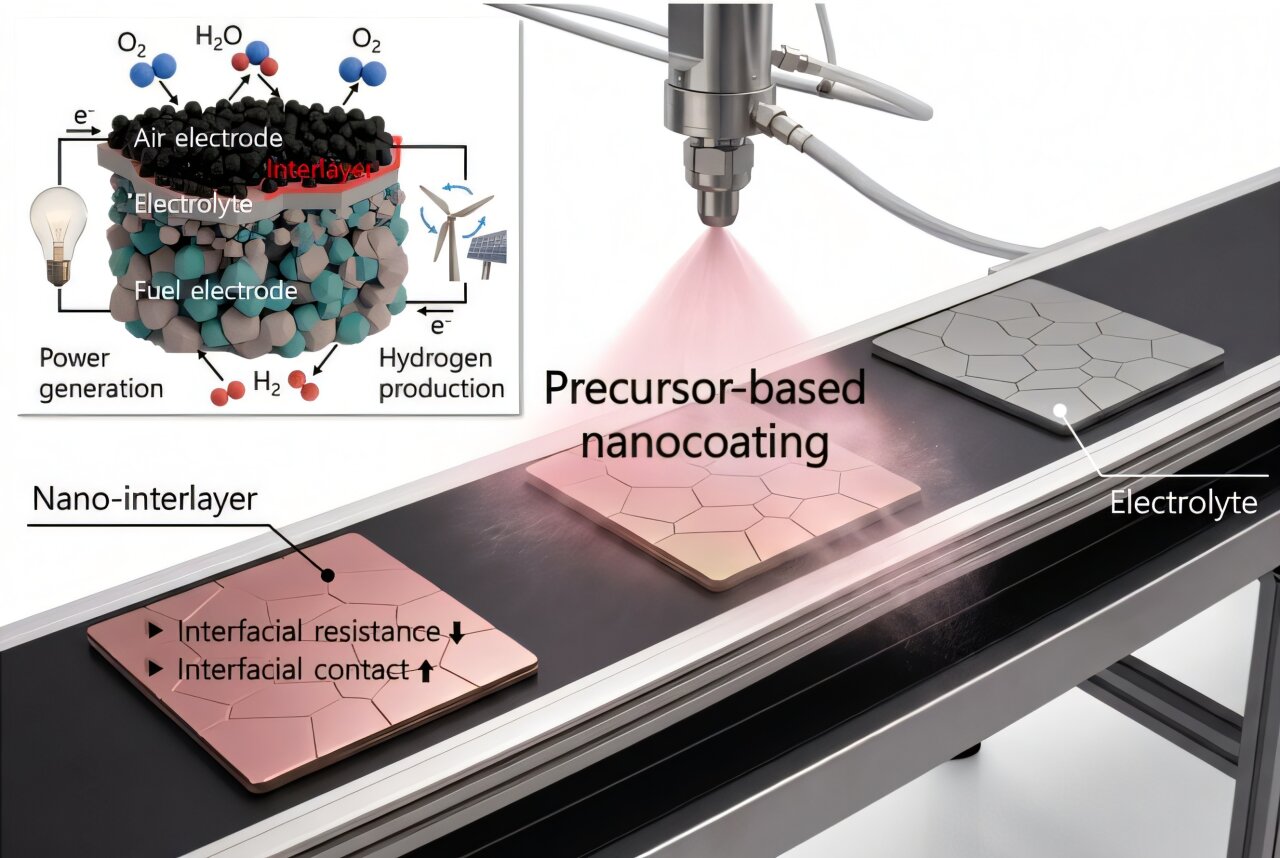
A research team led by professor Wonyoung Lee of the School of Mechanical Engineering at Sungkyunkwan University (SKKU) has developed a technology that addresses interfacial contact resistance, a key factor limiting the performance of protonic ceramic electrochemical cells (PCECs), a next-generation clean energy technology. The new approach improves both the energy efficiency and durability of the cells.
Protonic ceramic electrochemical cells (PCECs) are next-generation eco-friendly energy devices capable of operating in two modes within a single system: as fuel cells that generate clean electricity from hydrogen without producing pollutants and as electrolyzers that use electricity to split water and produce hydrogen.
Because PCECs can operate efficiently at lower temperatures than conventional devices, they are attracting attention as a key technology for the future hydrogen economy.
Within conventional cells, the interface between the dense, smooth electrolyte and the porous, sponge-like electrode often lacks complete physical contact. This creates undesirable interfacial contact resistance, preventing the materials from fully realizing their intrinsic performance.
To determine how the contact area between the electrode and electrolyte affects interfacial resistance, the research team fabricated experimental model cells with varying degrees of contact and conducted detailed analyses.
The results quantitatively demonstrated that interfacial resistance systematically decreases as the "contact coverage"—the proportion of the two components that are actually in physical contact—increases. Through this analysis, the researchers identified contact coverage as a key design parameter governing cell performance.
Source link