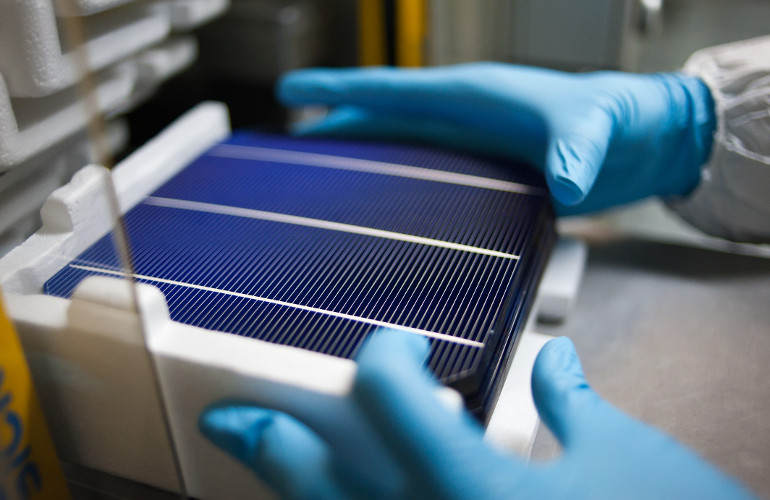
Researchers from the University of Stuttgart, Forschungszentrum Jülich, and German company Solarzentrum Stuttgart have modified a low-cost consumer digital camera to detect infrared radiation emitted by electrically biased silicon solar modules and measure their external quantum efficiency (EQE).
In PV devices, EQE describes how efficiently electrons passing through a solar cell are converted into emitted photons during electroluminescence. The parameter can be used to assess the radiative quality of a solar cell and determine its open-circuit voltage.
“Our approach shows that even a relatively inexpensive consumer camera can provide quantitative results when its physical response is properly modeled and calibrated,” lead researcher Jürgen Werner said. “An electroluminescence image contains much more quantitative information than simply showing bright and dark regions. With a suitable physical camera model and calibration, it can provide absolute luminescent quantum efficiency and, therefore, information about the local quality of a solar cell or module.”
The scientists explained that conventional digital cameras employ silicon-based complementary metal-oxide-semiconductor (CMOS) sensors that can detect both visible and near-infrared radiation, including part of the spectral range associated with electroluminescence (EL) from silicon PV devices. Consumer cameras, however, typically incorporate an infrared-cut filter that suppresses near-infrared radiation. This filter strongly attenuates the weak EL emission from silicon solar cells, limiting the use of unmodified consumer cameras for EL imaging and quantitative PV characterization.
The researchers used a Canon EOS 4000D camera and removed its infrared-blocking filter to increase its sensitivity to infrared radiation. They also used a Heliopan ES RG850 long-pass filter to block shorter-wavelength visible background radiation from reaching the sensor.
Source link