
This article has been reviewed according to Science X's editorial process and policies. Editors have highlighted the following attributes while ensuring the content's credibility:
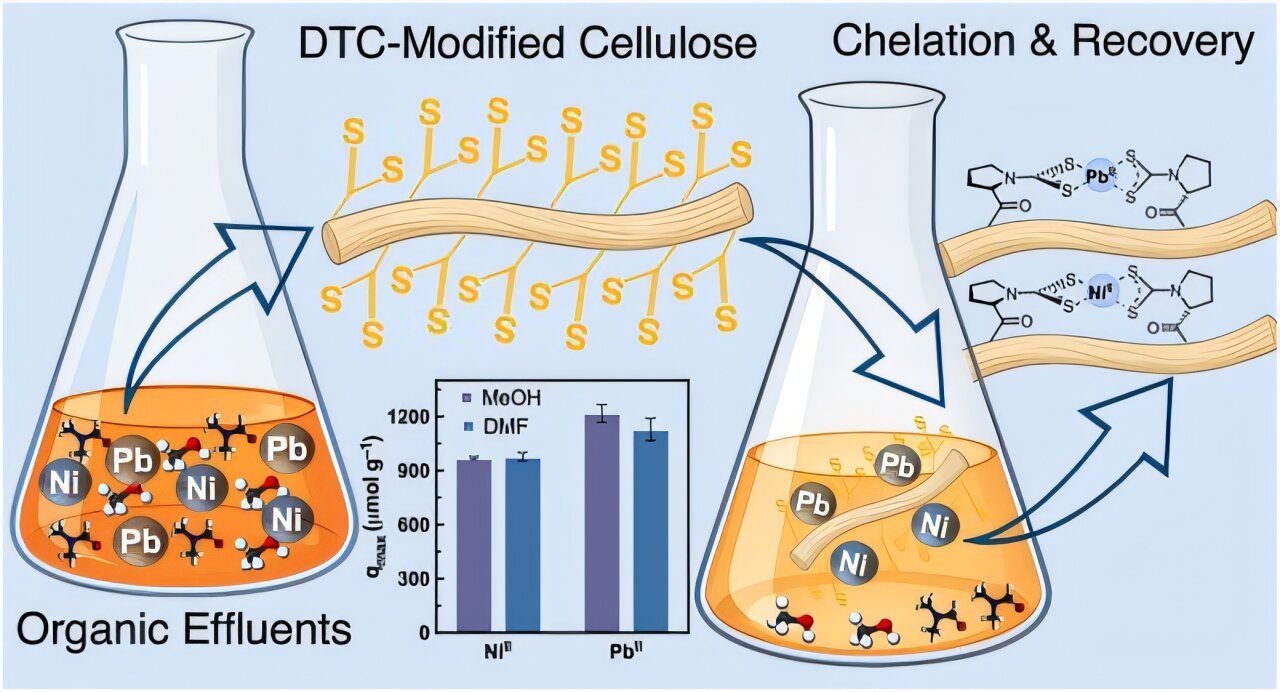
Conventional metal recovery technologies do not adequately recover critical metals from effluents containing hydrophilic organic solvents. Researchers investigated dithiocarbamate-functionalized cellulose DPE6 to assess how organic solvents affect its metal sorption capability and to develop a separation and recovery technology applicable to actual effluents. The results show highly efficient critical metal recovery and are expected to contribute to the effective use of finite metal resources and the realization of a sustainable society. The research is published in the journal ACS Applied Materials & Interfaces.
Critical metals are highly important resources for industry and society but carry high supply risks. They are used in a wide range of fields, including batteries, electronic devices and renewable energy–related technologies. To secure a stable supply of such resources, technologies are needed to recover and reuse metals contained in effluents and waste materials.
However, conventional separation technologies such as ion exchange and precipitation mainly target aqueous solutions. Effluents containing organic solvents have proved more challenging because the state of metal ions and the properties of effluents differ from those in an aqueous environment. Thus, it has been difficult for such technologies to achieve sufficient separation performance.
This study was conducted by a team of scientists from the College of Science and Engineering and the Nano Life Science Institute at Kanazawa University, the Institute of Environmental Radioactivity at Fukushima University, and Daicel Corporation.
Source link





