

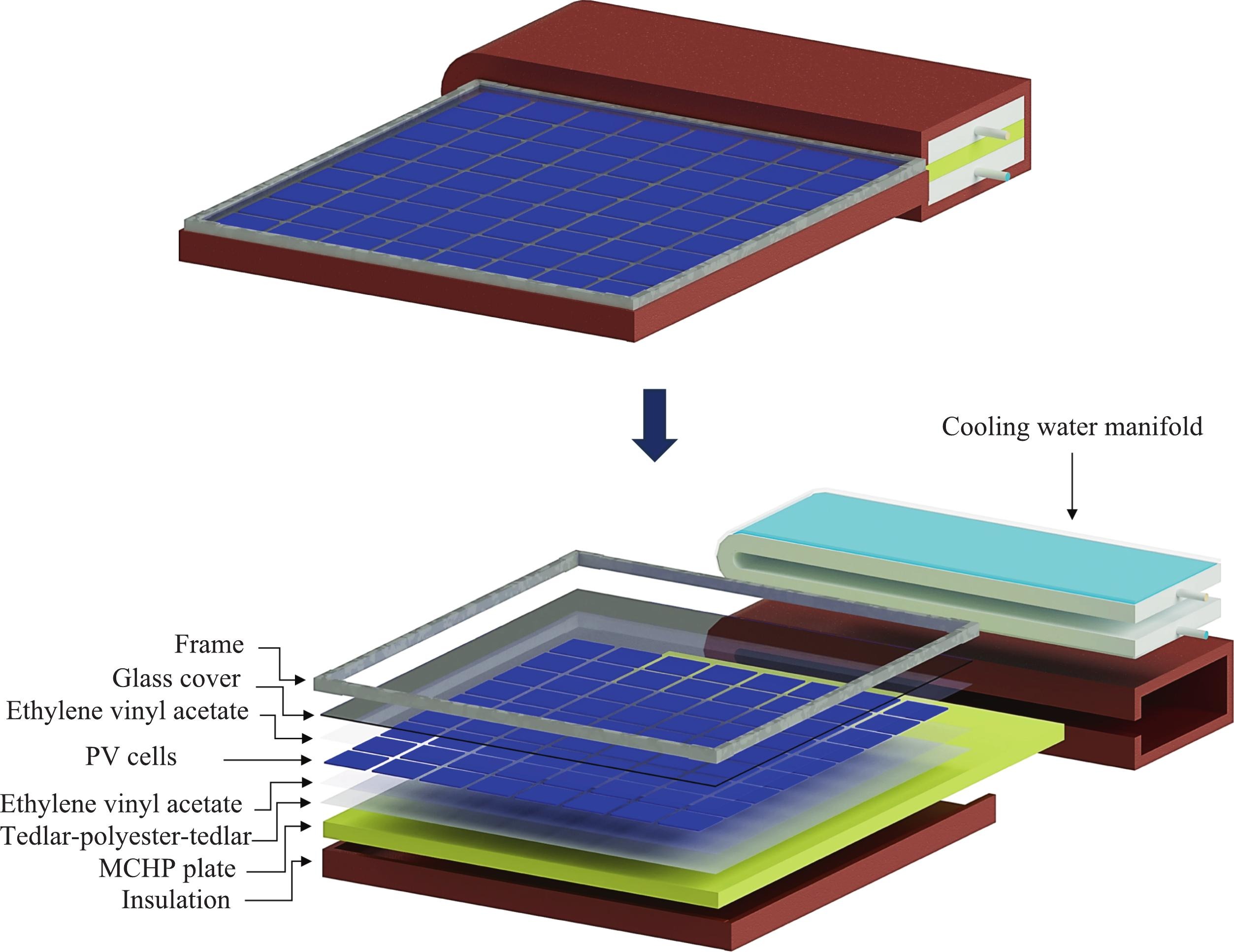
Scientists from the United Kingdom’s University of Nottingham and China’s Shandong Jianzhu University have developed a photovoltaic-thermal (PVT) module that uses a microchannel heat pipe (MCHP) to cool a solar panel and transfer waste heat to water.
The research team also developed a quasi-two-dimensional mathematical model to investigate the impact of key design parameters on the performance of the PVT-MCHP module.
“The optimal MCHP length ratio and cooling water flow rate are identified to provide practical design guidelines for balancing thermal efficiency against pumping power consumption,” the group explained. “Pumping power consumption is considered in electrical efficiency calculation to present a realistic assessment of net electrical energy output.”
The researchers initially developed the model in MATLAB to simulate heat transfer through the PV module, microchannel heat pipe, and water manifold. The model simulated refrigerant evaporation, condensation, and capillary return, while accounting for pumping power consumption in the calculation of net electrical efficiency.
The academics then built a prototype by bonding a commercial 210 W polycrystalline silicon solar panel to the evaporator section of a flat heat pipe via thermally conductive silicone. The heat pipe featured parallel channels with internal cross sections of 9 mm × 9 mm and axial grooves measuring 0.75 mm × 0.75 mm.
The scientists used R141b as the refrigerant and attached a dual-passage water manifold to the condenser section of the heat pipe. A pump circulated water through the manifold and a storage tank.
The team placed the prototype and a conventional PV panel side by side under an indoor solar simulator, with irradiance levels ranging from 200 W/m² to 940 W/m².
Source link





