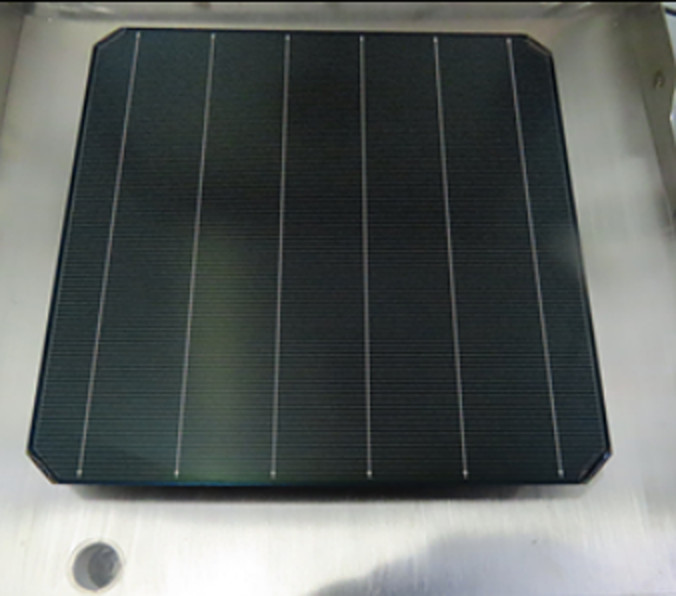
Chinese PV module manufacturer Longi announced today that it has achieved a power conversion efficiency of 28.29% for a hybrid interdigitated-back-contact (HIBC) solar cell.
The result was verified by Germany’s Institute for Solar Energy Research Hamelin (ISFH).
The achievement represents a world record for single-junction crystalline silicon solar cells and surpasses Longi’s previous record of 28.13%, which it achieved in May.
“Longi has broken the world records three times this year, pushing cell efficiency to 28.04%, 28.13% and 28.29%. The crystalline silicon solar cell efficiency is now approaching its technical ceiling, reaching 96.2% of the theoretical limit,” the company said, without providing further details about the cell technology.
Longi, however, outlined details of its HIBC solar cell architecture in a scientific paper published in November. The company said the device combines passivated tunneling contacts, dielectric passivation layers, and both n-type and p-type contacts.
The cell is built on a high-resistivity, half-cut M10 wafer featuring edge passivation and optimized n-type contacts produced through a combination of high- and low-temperature processes. An indium tin oxide (ITO) layer improves lateral transport, while multilayer aluminum oxide (AlOx) and silicon nitride (SiNx) coatings reduce surface recombination.
The researchers also reduced phosphorus doping in the n-type polycrystalline silicon layer to limit dopant diffusion into the wafer. The company’s in situ passivated-edge technology enables edge passivation during fabrication. In addition, deep-trenched metal fingers and selective ITO etching help prevent leakage between the n-type and p-type contacts, while a thicker amorphous silicon layer improves junction coverage and sidewall encapsulation.
Source link