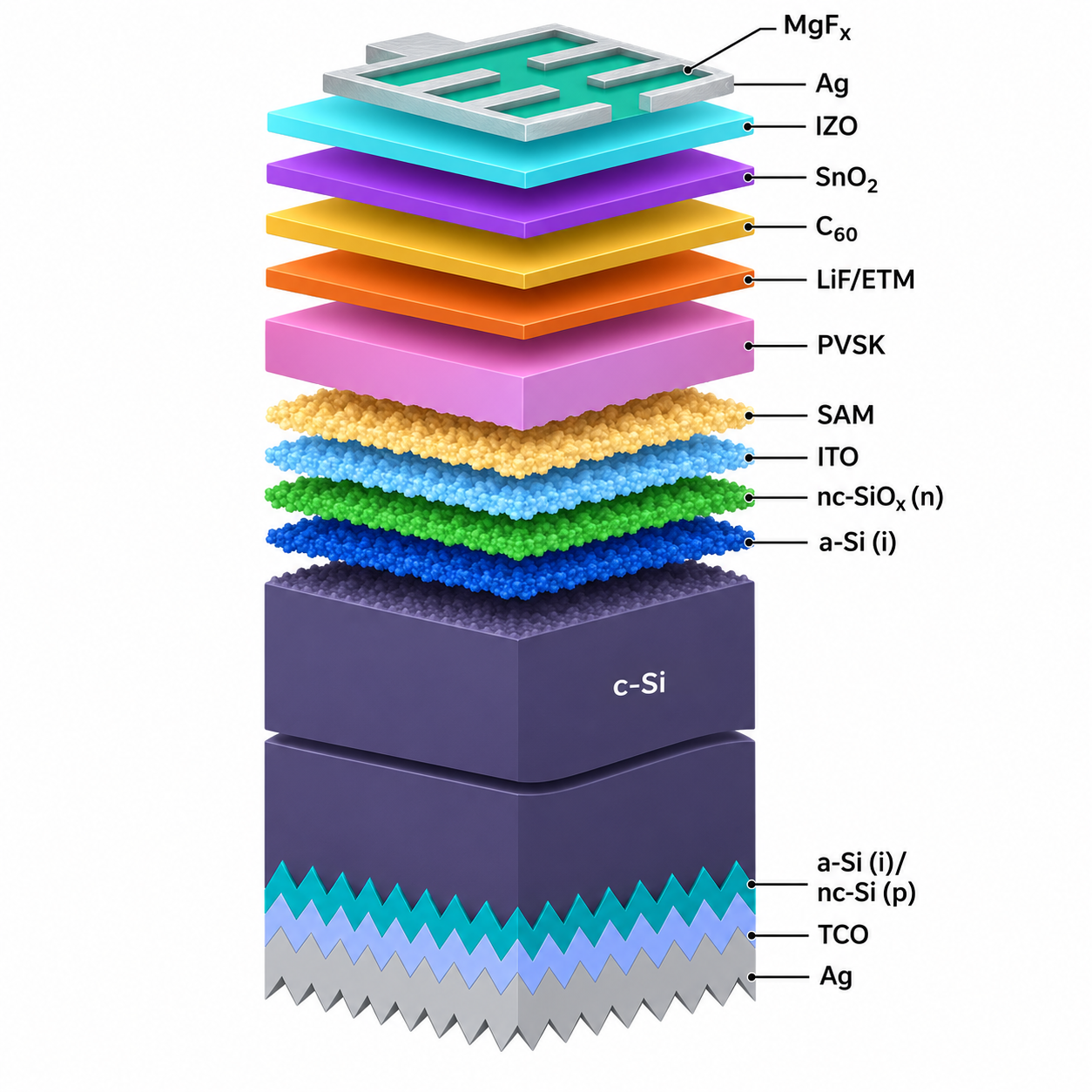
Chinese solar module manufacturer Longi has developed a perovskite-silicon tandem solar cell using specially designed molecules that suppress excessive molecular stacking while maintaining efficient charge transport.
“This molecular design promotes the formation of a uniform, well-organized self-assembled monolayer (SAM), even on rough, pyramid-textured surfaces,” Longi researcher Bo He told pv magazine. “By balancing molecular packing and surface coverage, the engineered interface improves energy-level alignment for faster charge extraction, reduces defects through molecular flexibility, and provides a stable foundation for the growth of high-quality perovskite films.”
The researchers explained that conventional SAM molecules often suffer from excessive aggregation, resulting in uneven coverage on textured silicon surfaces. To address this limitation, they designed molecules with controlled molecular twisting and conjugation. They developed four SAM derivatives – TC0, TC1, TC2 and TC3 – based on the commonly used 4PACz molecule.
TC2 offered the best balance between molecular packing, substrate adhesion and charge transport, as its structure combines a conjugated backbone with a moderately twisted phenyl side group. Molecular simulations showed surface coverage of 83.1%, compared with 75.0% for TC1 and 73.3% for TC3. Experimental measurements confirmed that TC2 achieved more than 80% coverage and exhibited strong anchoring stability.
The improved molecular arrangement also enhanced the electronic properties of the interface between the indium tin oxide (ITO) layer and the perovskite absorber. In particular, TC2 modified the ITO work function and provided favorable energy-level alignment for efficient hole extraction. This strengthened the internal electric field, accelerating charge separation and transport, while improved interface coverage reduced defects and suppressed charge recombination.
Source link