During its recent 2026 Solar Analyst Day on 6 October, TOYO Co., Ltd. (TOYO) provided key updates on its U.S. manufacturing operations, coinciding with the ribbon-cutting ceremony for its module expansion in Humble, Texas.
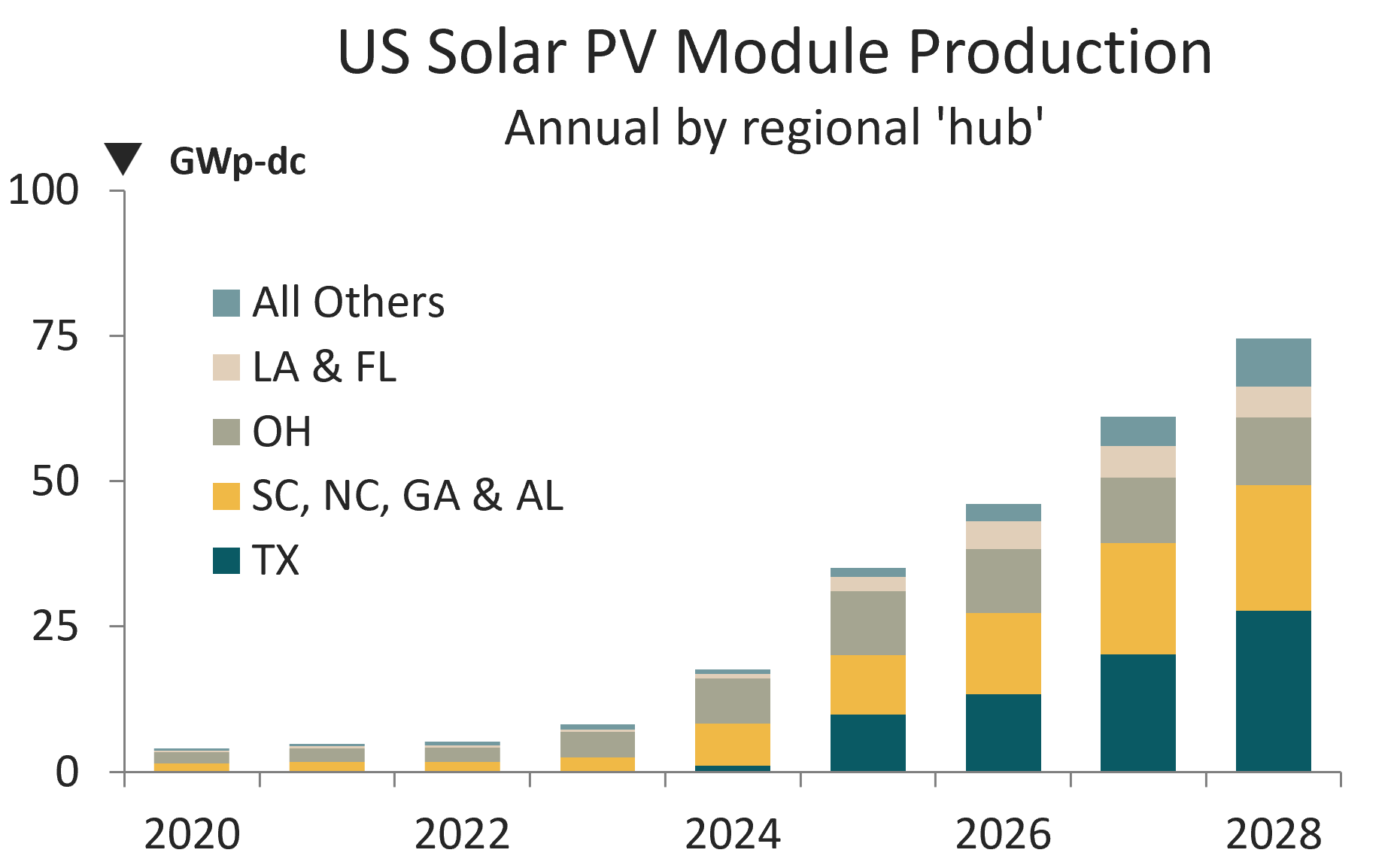
While the presentation largely echoed the company’s first-half 2026 financial results, it offered valuable insight into management’s perspective on the broader U.S. solar landscape. Specifically, TOYO highlighted that operational U.S. module capacity has reached roughly double the projected 43 GW of domestic annual demand. As a consequence, the United States no longer requires additional module capacity.
This market assessment likely serves, in part, to explain why TOYO is bypassing further U.S. module expansions. It also contextualises why the broader Abalance/TOYO/VSUN cell production strategy has migrated so rapidly from Vietnam to Ethiopia, and ultimately directly into the United States.
While a detailed critique of the global manufacturing strategy across Abalance, VSUN, and TOYO is worth revisiting in the coming months, management’s commentary cuts directly to the heart of a much larger industry unknown: exactly how much domestic production the United States actually needs over the next decade.
S. solar module shipments was rarely essential, serving primarily as a tool for tracking general market trends. Because the United States lacked a domestic supply base capable of accounting for the majority of its module consumption, market sizing and forecasting were largely academic exercises. Aside from First Solar, forecasting was largely a matter of calculating exactly how many gigawatts would be imported into the country, particularly from Southeast Asia.
Source link